Roughly one in ten West Australians - more than 295,000 people on the most conservative estimate - lives in a strata-titled home, and the state's land register now carries more than 340,000 strata lots. Western Australia has also installed more than 548,000 small-scale solar systems. The overlap between those two groups is small, and the reason is not the sun. It is governance: who owns the roof, who signs the connection application, who is allowed to sell the power, and who carries the risk if a resident is overcharged.
Between 2020 and 2026, Western Australia rewrote all three of the rulebooks that answer those questions. The Strata Titles Act lowered the vote. The federal battery programme extended its discount to apartments and bodies corporate. And in August 2026 the state made the regulations and the first code under its Alternative Electricity Services framework, which decides who may sell solar power to residents and under what protections, with registration dates of 1 February and 1 July 2027. This article puts the three rulebooks side by side so that a lot owner, a strata council or a strata manager can see which applies to the system they have in mind.
Why 2027 is the year strata solar gets rules of its own
- On 25 August 2026 the Electricity Industry (Alternative Electricity Services) Regulations 2026 and the AES Code of Practice for On-site Power Supply services were made; consultation on the draft single property network code closed on 25 September.
- On-site power supply providers must register with the Economic Regulation Authority and join the Energy and Water Ombudsman WA scheme from 1 February 2027. Single property network providers - the new legal name for embedded networks - register from 1 July 2027, a date deferred to give schemes time to prepare.
- Service providers report more than 450 WA strata schemes already configured as embedded networks, according to the Strata Community Association (WA). Each will need a registered seller by mid-2027.
- The federal Cheaper Home Batteries Program, which treats apartment buildings and embedded networks as eligible premises, steps its certificate factor down from 6.8 to 5.7 per kWh for installations from 1 January 2027.
- Landgate's five-year review of the Strata Titles Act is under way, and its discussion paper asks whether the 2020 sustainability-infrastructure reforms have worked. The sector's answer is "partly": schemes still find solar, EV charging and embedded networks difficult to install.
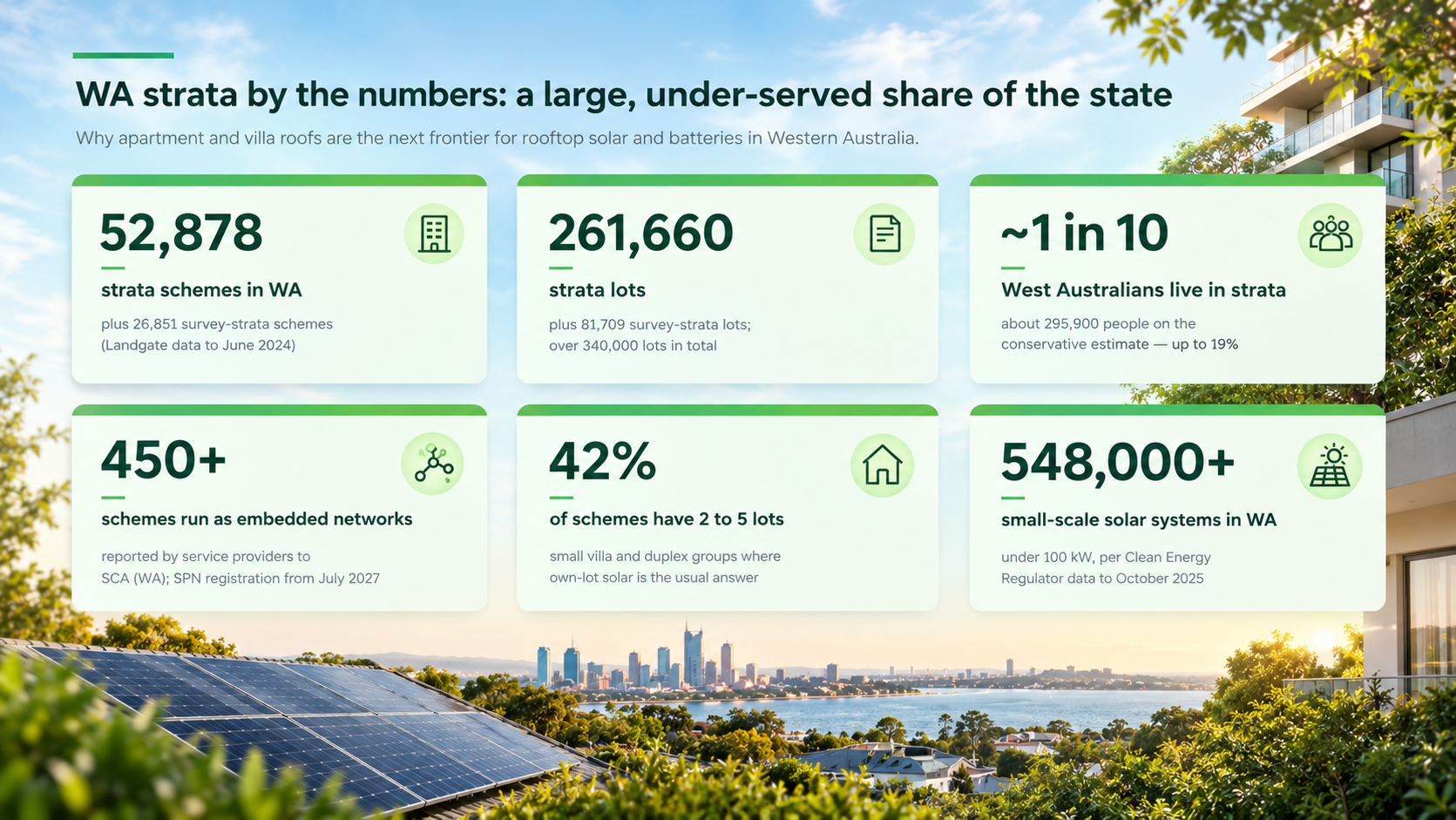
Figure 1. The scale of WA's strata sector against the state's rooftop solar base.
Four ways solar gets onto a strata roof
Almost every strata solar proposal we see in Perth is one of four arrangements, and which one you are proposing determines which rulebook you are in. Name it before the first quote is requested.| Arrangement | Who owns it | Who benefits | Which rules apply |
|---|---|---|---|
| 1. Own-lot system - a villa, townhouse or top-floor unit with roof access and its own Western Power meter | The lot owner | That lot | Strata consent (by-laws or a section 64 easement); Western Power standard connection; DEBS if the owner is a residential customer. Not an alternative electricity service, because the owner supplies only themselves. |
| 2. Common-property system - an array feeding lifts, lighting, pumps, the pool or car-park EV chargers | The strata company | All owners, through lower levies | Sustainability-infrastructure resolution under the Strata Titles Act; Western Power connection on the common-property meter, which is usually a business account and so earns no DEBS. Not an AES. |
| 3. Shared-allocation system - one array split behind the meter among several lots' own grid meters | The strata company or a third party | Participating lots | Ordinary resolution plus an infrastructure contract; Western Power approval for the connection point. If a third party owns the system and sells its output, it is an on-site power supply service (register from 1 February 2027). |
| 4. Single property network - a master meter at the boundary, sub-meters for each lot, central solar and battery | The strata company or a network operator | Every occupant | Ordinary resolution plus supply agreements; one network connection point; the operator is a single property network provider and must register with the ERA from 1 July 2027, comply with the SPN code and join the Ombudsman scheme. |
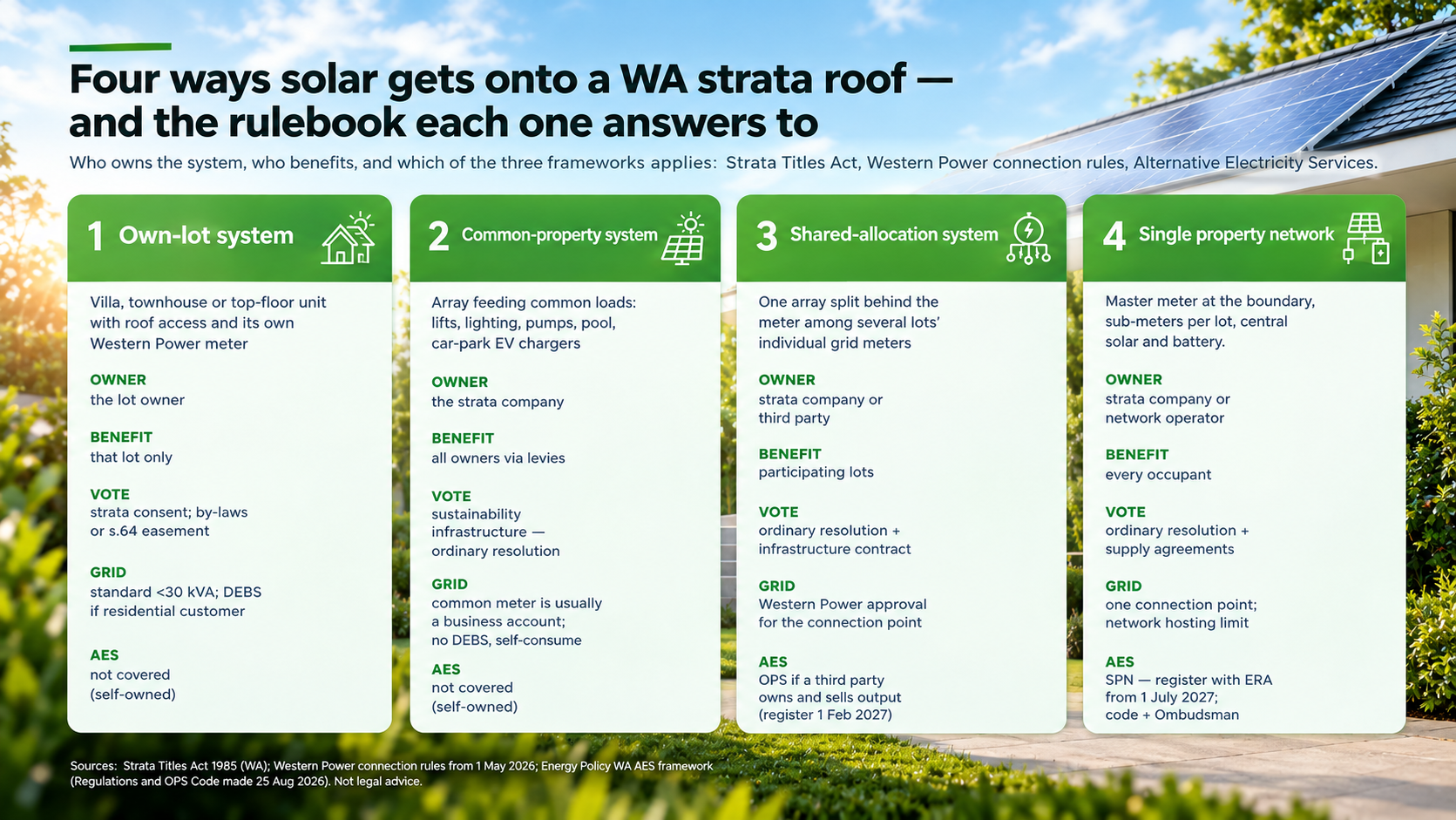
Figure 2. Four arrangements for strata solar in WA and the framework each one answers to.
The vote: sustainability infrastructure under the Strata Titles Act
Before 1 May 2020, putting solar on a WA strata roof could require every owner to agree. The Strata Titles Act reforms that commenced on that date created a category of "sustainability infrastructure" - defined in section 3 as infrastructure designed, or likely, to avoid, remedy or mitigate adverse effects on the environment, with solar panels, clothes lines and rainwater tanks as the examples. Batteries and EV chargers are not named, but strata practitioners generally treat them as within the definition; confirm this for your scheme.
The practical effect is in the voting threshold. An improvement to common property costing more than $500 a lot ordinarily needs a special resolution; sustainability infrastructure is carved out and can be authorised by an ordinary resolution - a simple majority. Section 64 added "infrastructure contracts" and short-form easements, so a strata company can agree with an infrastructure owner (a lot owner or a third party) on installation, access, operation and removal without registering an exclusive-use by-law.
What the Act does not settle, as Landgate's review concedes, is who owns and maintains infrastructure that serves one or a few lots, and who pays when conduits must run through other lots. Those questions fall to by-laws and contracts. A proposal that arrives at a general meeting with a draft infrastructure contract, a maintenance and insurance schedule and a removal clause is far more likely to pass than one that arrives with a quote.
The grid: Western Power's rules for shared roofs
The Strata Titles Act decides whether you may build; Western Power decides whether you may connect. Three rules matter.- One site, one hosting limit. Since 1 May 2026 a standard SWIS connection carries up to 30 kVA of total inverter capacity, solar and battery combined, and new or upgraded systems must be remotely manageable by the network or accept a fixed 1.5 kW export limit. In a building with one connection point, that capacity is shared by everyone who wants to connect.
- The multi-residential pathway. Western Power publishes a conditional exemption that lets a body corporate or strata manager apply once for the whole connection point: each residence may install an inverter system under 5 kVA, the site aggregate is capped at 500 kVA or the hosting capacity, every inverter must be AS/NZS 4777.2 certified, and an independent certifier must confirm the site's electrical installation. Residents then quote the site's exemption code when they install. The published document dates from 2018, so confirm the current limits with Western Power.
- Who earns the buyback. The Distributed Energy Buyback Scheme pays 10 cents a unit for exports between 3pm and 9pm and 2 cents otherwise, but only to residential customers, schools and not-for-profits with systems of 5 kW or less. A lot owner with their own residential account qualifies. A strata company's common-property meter is almost always a business account, so a common-property array earns nothing for exports and should be sized to the common load - or paired with a battery that carries the lifts, corridor lighting and pumps through the evening.
The money: which rebates reach apartments
Two programmes are relevant and they treat strata differently.- The federal Cheaper Home Batteries Program treats apartment buildings and premises inside embedded networks as eligible, and the claim can be made by an individual, a business or a body corporate. One battery per premises, paired with rooftop solar and VPP-capable; the discount covers the first 50 kWh of usable capacity, tiered at 100 per cent of the certificate factor on the first 14 kWh, 60 per cent to 28 kWh and 15 per cent to 50 kWh. The factor is 6.8 per kWh to 31 December 2026 and 5.7 from 1 January 2027.
- The WA Residential Battery Scheme requires the applicant to own, or rent with consent, "a standalone home or unit with a title", to be a Synergy or Horizon Power customer, and to install a 5 to 10 kWh battery with a two-year virtual power plant agreement. A unit owner with their own retail account can therefore qualify for the $1,300 Synergy-area or $3,800 Horizon-area rebate. The constraint is where the battery can go and whether the strata company consents, not the scheme itself.
The regulator: who becomes an alternative electricity service provider
Part 3A of the Electricity Industry Act 2004, inserted by the amendment Act that passed Parliament in April 2024, lets the state prescribe "alternative electricity services" - ways of supplying electricity that are not a licensed retailer. The Regulations made on 25 August 2026 prescribe two.Single property networks
A single property network is a private electricity network serving several lots or tenancies on one property, behind a master meter that connects the property to the grid. The provider may be the property owner or a contracted third party - and in many Perth apartment buildings, the SCA (WA) notes, the entity legally responsible for supplying residents is the strata company itself. From 1 July 2027 that provider must be registered with the Economic Regulation Authority, be a member of the Energy and Water Ombudsman WA scheme and comply with the SPN code once made. The draft code, modelled on the voluntary code in place since February 2024, covers written supply agreements and disclosure statements, itemised bills, individual metering, hardship and family-violence policies, disconnection procedures, a life-support register and dispute resolution. Until now, embedded-network customers have had none of the Ombudsman access or ERA oversight that licensed-retailer customers take for granted.On-site power supply
An on-site power supply service is one where a provider owns an energy system - solar, a battery or both - on the customer's property and sells the customer its output, per unit or by subscription. Systems the customer owns outright or finances through a bank are explicitly not OPS. The OPS code has been made, and providers must register from 1 February 2027. For strata the relevance is direct: a solar-as-a-service or power-purchase arrangement for a common-property or shared system puts the provider inside the framework, with code obligations the strata company should read before it signs.What the strata sector asked for
The Strata Community Association (WA) supported consumer protection but told Energy Policy WA the draft regulations were disproportionate for small schemes. It asked for an exemption for schemes of twenty lots or fewer and simplified pathways for legacy arrangements that on-sell at cost; warned that converting a legacy scheme to individual grid meters often costs more than $30,000; and argued that owner-controlled networks with shared solar and communal batteries could become unviable for all but the largest schemes - working against the sustainability reforms the Strata Titles Act introduced. Whether the final Regulations adopted those exemptions is a question for the Regulations as made and the ERA's registration guidance; councils should ask their manager rather than assume.“The design decision this creates: a strata council that wants to own and share a system must decide, before design, whether it is building a single property network - with registration, a code and billing systems - or keeping every lot on its own grid meter and sharing behind the meter.”
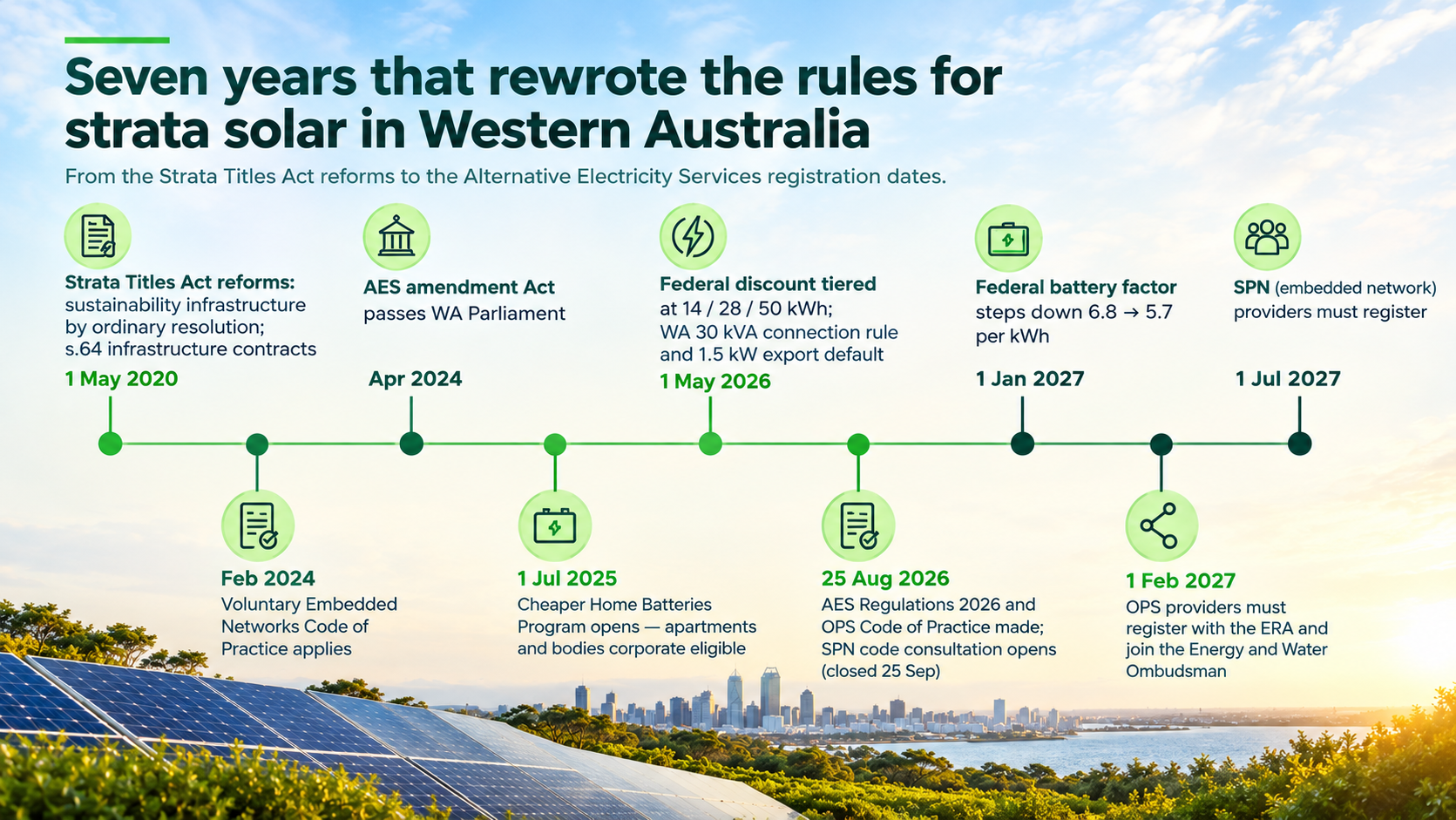
Figure 3. The reforms that reshaped strata solar in WA, from the 2020 Strata Titles Act changes to the 2027 AES registration dates.
What the White Gum Valley trial taught Perth
Western Australia has already run the experiment the AES framework now regulates. The Curtin University Sustainability Policy Institute, with ARENA funding, studied three strata buildings at White Gum Valley in Fremantle - of three, fourteen and twenty-four dwellings - each with a shared rooftop array and a central battery owned as common property, the strata company acting as what the researchers called a "citizen utility" and residents billed through a peer-to-peer platform.
The results, published in January 2021, are the best WA evidence we have. Renewables met about 60 per cent of residents' demand, and resident demand ran about 57 per cent below a typical Perth apartment benchmark. Only the smallest building returned a positive net present value without grant funding. And the barriers the report listed read like a design brief for the rules that followed: the split incentive between owners and tenants, paybacks of seven to eight years competing with sinking funds, limited roof area in taller buildings, Synergy's retail franchise and Western Power's one-user-per-connection-point policy, certification delays approaching a year, and strata managers whose systems were built for sub-metered billing rather than for running a network.
Read against that list, the AES framework is the state's answer to the governance gap White Gum Valley exposed. It legitimises the strata-as-utility model with a registration category, a code and an Ombudsman, and attaches licence-like obligations in return. That is the trade every council considering a shared system now has to weigh.
What this means for owners, councils and managers
- If you own a villa, townhouse or unit with its own meter and roof access, the simplest path is your own system: strata consent by ordinary resolution or by-law, a section 64 easement if the panels sit on common property, a standard Western Power connection, and DEBS and both battery rebates as a residential customer. Bring a draft infrastructure contract to the meeting.
- If you sit on a strata council, start with the common-property load. Lifts, car-park lighting, pumps and a pool are evening and overnight loads with no export value, which makes a common-property array and a modest battery the arrangement with the clearest economics and the least regulatory weight: sustainability infrastructure, an ordinary resolution, and not an alternative electricity service.
- If your scheme already runs an embedded network, identify the seller now. If it is the strata company, it must register by 1 July 2027 or appoint an operator who will, and budget for the code's billing, hardship and metering obligations. Committees often take three to six months to make decisions of this size.
- If you are weighing a shared system or a third-party offer, ask one question first: does this make us, or our provider, an SPN or OPS provider? The answer decides the switchboard, the metering, the contracts and the compliance cost, and belongs before the design is commissioned.
Regen Power's perspective
Regen Power does not manage strata schemes or operate embedded networks; we design, install and maintain the systems, and have done so in Western Australia since 2003 across more than 45,000 installations, with in-house electricians under contractor licence EC9676 and as a Clean Energy Council Approved Retailer. That position is useful to a strata council precisely because we have no interest in which of the four arrangements it chooses - only in the arrangement being sized to the load, compliant with AS/NZS 5139 and Western Power's rules, and documented well enough to pass at a general meeting.
The shared-battery question is also one we are researching formally. Our ARC Linkage project with Curtin University is building AI-driven methods for sizing and profiling batteries against real load data - the problem White Gum Valley met when one of its systems proved undersized for its residents' daytime use. For strata, getting the size right is the difference between a sinking-fund asset and a sinking-fund liability.
“Next step. Ask Regen Power for a strata solar and battery feasibility review. We survey the roof and the switchboard, obtain the common-property interval data, confirm the Western Power connection pathway and the AS/NZS 5139 battery location, and set out the four arrangements with their costs, votes and regulatory obligations — in a format your council can table at its next meeting.”