At 30 June 2026 there were 63,241 electric vehicles licensed in Western Australia, up from 38,110 a year earlier. In the June quarter alone, one in four new light vehicles licensed in the state was a plug-in. Most of those cars will do most of their charging in a Perth garage or carport, overnight or from the roof, through a piece of equipment that many owners choose in about ten minutes and many installers quote in about the same.
That is the wrong way round. The charger is a mature, largely interchangeable product. What decides whether home charging in Perth is cheap, safe and compliant is how it is connected: to a 63-amp single-phase supply that already carries an oven, a ducted air-conditioner and a hot-water system; to a switchboard that Western Power now requires to have a circuit breaker as its main switch; and to a tariff that can make the same kilowatt-hour cost anywhere between 9 and 55 cents depending on when it flows. This article sets out those decisions in the order a Perth homeowner meets them.
Why Perth's garages electrified in 2026
Three things lifted WA's EV numbers. The state's $3,500 Zero Emission Vehicle rebate closed to applications on 10 May 2025 after paying 14,424 rebates worth $50.5 million, and growth continued without it: the Department of Transport counted 10,727 new EV licences in the June 2026 quarter, 24 per cent of all new light-vehicle licences and a 20 per cent rise on the March quarter. The WA EV Network - 110 charging points across 49 locations from Mundrabilla to Kununurra - has been fully operational since January 2025, which took the range argument off the table for regional travel. And the federal fringe-benefits-tax exemption for battery electric vehicles remains in place for novated leases, even though plug-in hybrids lost it from 1 April 2025.
The result is a fleet that is still small - 2.8 per cent of the state's 2.2 million light vehicles - but concentrated in the suburbs where rooftop solar is densest, and growing at about two-thirds a year. The home charger has quietly become the fourth appliance of the electrified Perth house, after the solar array, the battery and the heat pump.
Three charging speeds, and why your car sets the ceiling
Home charging comes in three speeds, and the names used in brochures hide a simple arithmetic.| Method | Supply | Power | Range added per hour | Full charge, 60 kWh battery |
|---|---|---|---|---|
| Portable cable in a standard socket (Mode 2) | 10 A single-phase | about 2.4 kW | 12–15 km | 25 hours or more |
| Wall charger, single-phase (Mode 3) | 32 A single-phase | 7.4 kW | about 40 km | about 9 hours |
| Wall charger, three-phase (Mode 3) | 16 A per phase | 11 kW | about 60 km | about 6 hours |
| Wall charger, three-phase (Mode 3) | 32 A per phase | 22 kW | up to 125 km | limited by the car |
Range per hour assumes roughly 17-18 kWh per 100 km and varies by vehicle. Sources: Western Power standard connection capacities; manufacturer onboard-charger specifications; SolarQuotes charger comparison.
Two facts shape the choice. The first is that a Western Australian passenger car travels about 12,400 kilometres a year - roughly 34 kilometres a day, or five to six kilowatt-hours of charging. A 7.4 kW single-phase charger replaces a typical day's driving in well under an hour and fills a 60 kWh battery overnight. The second is that the car, not the wall unit, sets the ceiling. Every EV has an onboard AC charger with a fixed maximum: a Tesla Model 3 or Model Y accepts 7.4 kW on single-phase and 11 kW on three-phase; the BYD Sealion 7 and Kia EV5 accept 11 kW; the BYD Atto 3 and most MG4 variants are capped at 7 kW or less. A 22 kW charger on a car that accepts 7 kW charges at 7 kW.
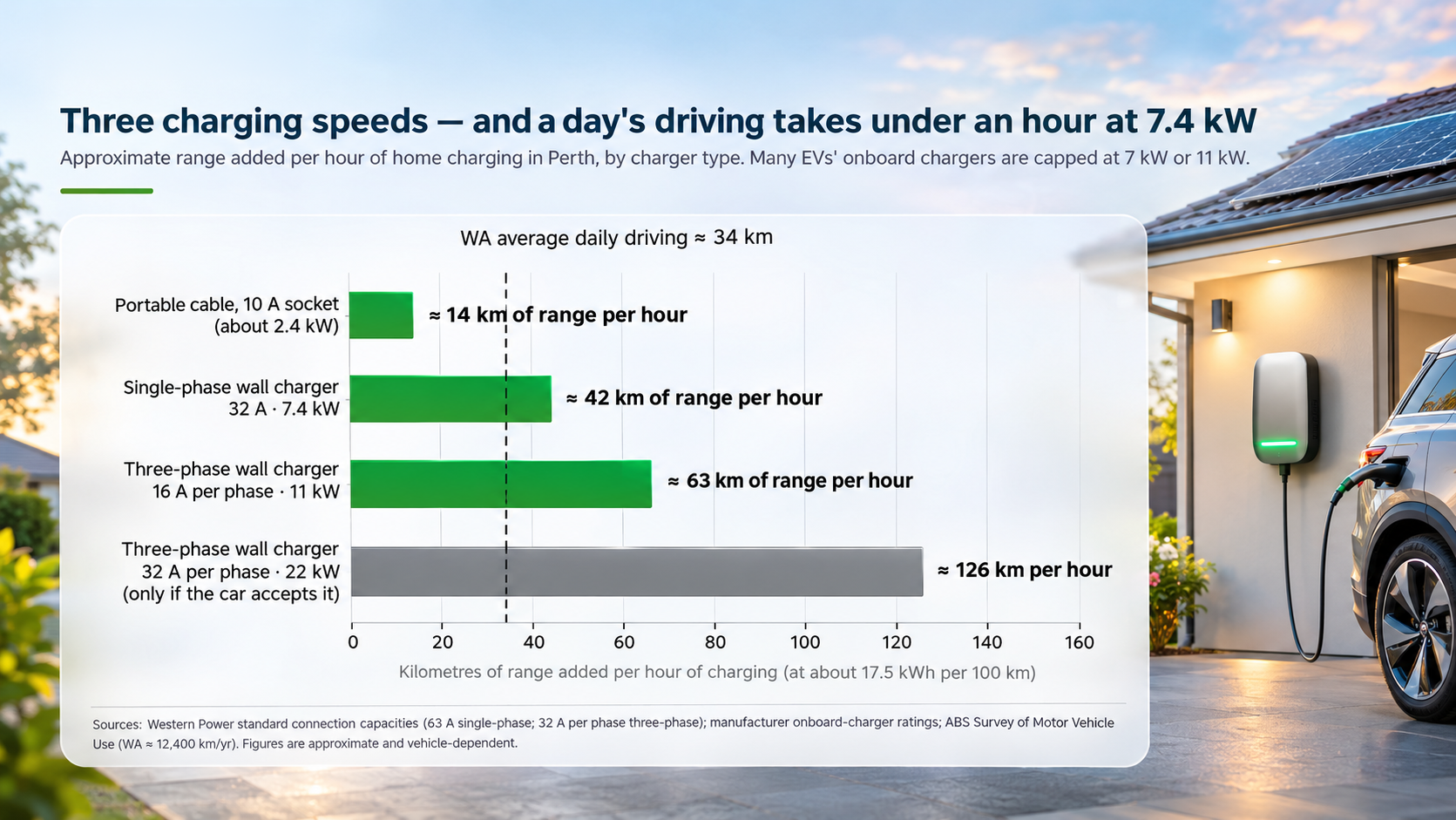
Figure 1. Range added per hour at each home-charging speed, against a typical WA day's driving.
For most Perth households, then, the question is not "how fast" but "does a 7.4 kW single-phase charger fit my home's supply" - and that is a Western Power question before it is a product one.
What Western Power requires of a home charger
Western Power's standard connection service - the supply a Perth home receives without paying for an upgrade - is 63 amps on single-phase at 240 volts, or 32 amps per phase on three-phase at 415 volts, a standard that has applied across the South West Interconnected System since 11 April 2023. Everything in the house, including the charger, has to fit inside that allocation.
The 63-amp question
Western Power's guidance on EV charging installations, which cites clause 10.11.6 of the WA Service and Installation Requirements, is clearer than most homeowners expect. A 7 kW single-phase charger "is permitted on either single or three phase sites" with a standard connection, provided the electrical contractor confirms that the home's maximum demand stays within the connection's capacity. The rated current of the charger must not push the total load limit over. If it would, the contractor has two sanctioned paths: apply to Western Power for an upgraded connection, or "use advance methods to control load on site such as installing a smart EVSE with grid import limiting functionality".
Two further points sit in the same guidance. For EV charging connections, the consumer's main switch must be a circuit breaker - many older Perth switchboards still have a plain main switch, and that becomes an upgrade item on the quote. And the consumer mains feeding the switchboard must be at least 10 mm² copper on a single-phase home, which older houses do not always have.
The paperwork your electrician handles
A Mode 3 wall charger must be installed by a licensed electrical contractor; the only charging equipment a homeowner may set up unaided is a portable Mode 2 cable in an existing socket. Under WA's Electricity (Licensing) Regulations, adding a single final sub-circuit is not by itself "notifiable work", but all electrical installing work must be covered by an Electrical Safety Certificate issued to the owner within 28 days, and notifiable work - which can include switchboard and main-switch changes - needs a preliminary notice to Western Power before it starts and a notice of completion within three days. A compliant installer treats these as part of the job.
The maximum-demand problem, and the smart-charger answer
The reason the 63-amp question bites is a rule in the Wiring Rules, AS/NZS 3000. When an electrician calculates a home's maximum demand under Appendix C, most appliances are diversified - cooking appliances count at 50 per cent of their rating and fixed air-conditioning at 75 per cent - because they do not all run flat out at once. EV charging equipment is counted at 100 per cent of its connected load. A 32-amp charger adds a full 32 amps to the calculation.
Add that to a home that already runs an induction cooktop, a ducted reverse-cycle system and an electric hot-water unit and the total passes 63 amps on paper, even if it rarely would in practice. Industry worked examples put a typical existing load at 38 amps, which with a 32-amp charger comes to 70. The electrician then chooses between the two Western Power paths, and the cheaper and faster is almost always load management: a smart charger that reads the home's total import at the meter and throttles itself so the house never exceeds the supply. On a hot evening with the air-conditioner running, the car charges more slowly; at two in the morning it takes the full 7.4 kW. The Wiring Rules permit the limitation method, and Western Power endorses it.
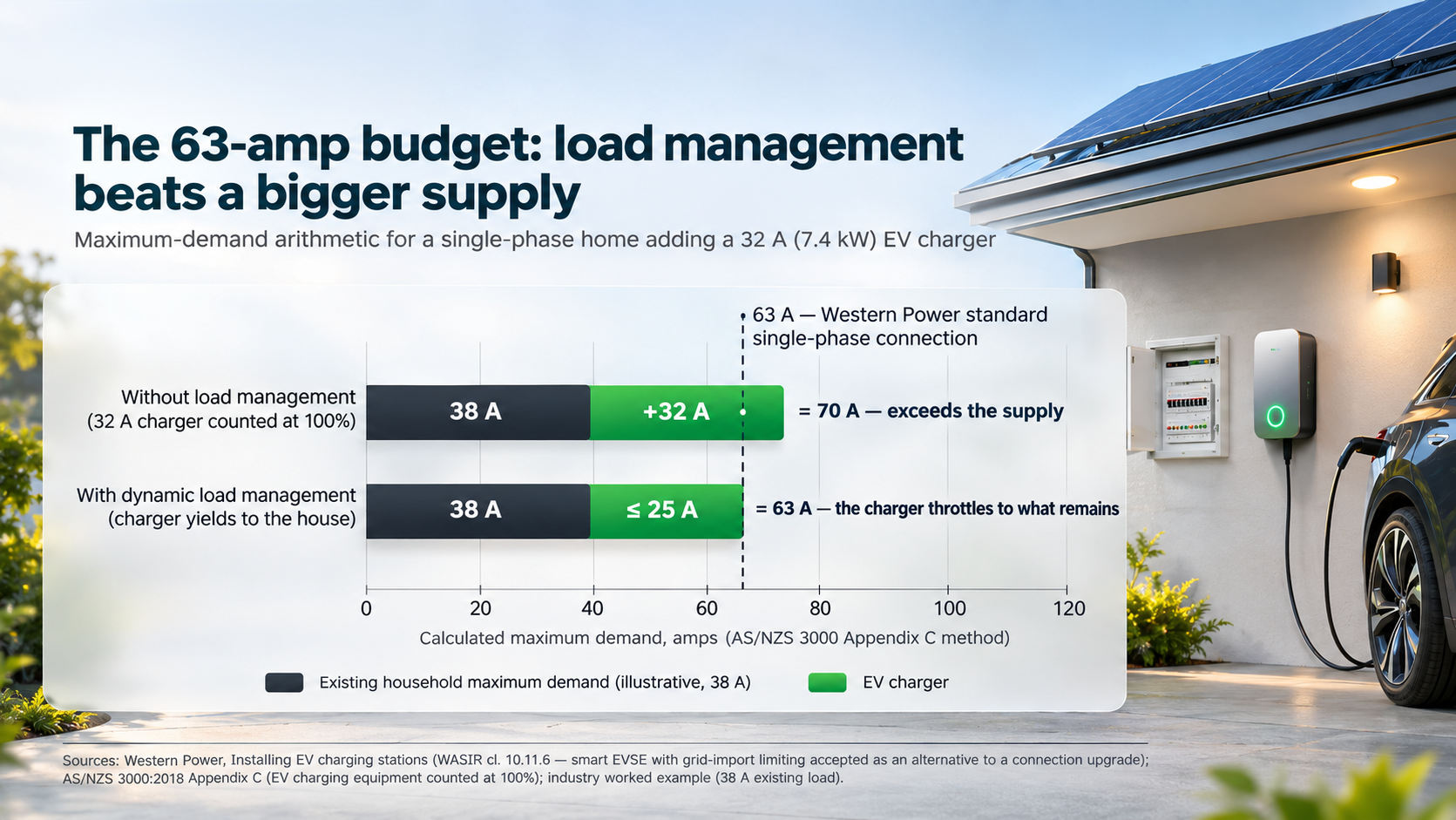
Figure 2. The 63-amp budget: how dynamic load management keeps a 32 A charger inside a standard single-phase connection.
Three further things belong on the circuit. The charger should be on its own dedicated final sub-circuit - the Electric Vehicle Council's position, and ours. It needs the right residual-current protection: a Type A RCD is acceptable where the charger itself detects DC fault current above 6 mA, which most current units do; where it does not, a Type B device is required, and since the 2023 transition Type AC devices may not be installed at all. And the cable run should be sized for 32 amps over the full distance to the parking bay, not for the 16-amp unit someone might have fitted in 2019.
If a quote for a 32-amp charger on a single-phase Perth home does not mention maximum demand, load management or the main switch, the installer has not yet looked at your switchboard.
Where load management is not enough - a large all-electric home with a pool heat pump, or a household that wants 11 kW charging for two cars - the alternative is converting the supply to three-phase. That is a larger decision with its own rules on inverter capacity, phase balance and battery backup, and we deal with it in the companion article, Single-phase or three-phase? The decision Perth homeowners face before adding solar, a battery or an EV charger.
Charging from your roof: solar-smart charging and the tariff decision
An EV is the largest flexible load most households will ever own, and in Western Australia the hours it charges in are worth more than the hardware it charges through.
Solar-smart charging is the first lever. A charger with a current-transformer clamp, or a data link to the inverter, tracks the home's surplus solar and raises or lowers its output so the car absorbs what would otherwise be exported. The floor is set by the charging standard: an EV will not charge below 6 amps, about 1.4 kW on single-phase, so on a cloudy afternoon the charger either waits or tops up from the grid, depending on its settings. Since 1 July 2024 the Distributed Energy Buyback Scheme has paid 10 cents a kilowatt-hour for exports between 3 pm and 9 pm and 2 cents at other times. Midday solar sent to the grid earns 2 cents; the same energy in the car displaces petrol, or grid electricity at 33 cents.
Which Synergy plan suits an EV household
| Plan | Rate (c/kWh inc. GST) | Daily supply charge |
|---|---|---|
| Home Plan A1 (flat) | 33.2621 at all hours | $1.1924 |
| Midday Saver | 8.85 super off-peak (9 am–3 pm) · 55.33 peak (3 pm–9 pm) · 24.34 off-peak (9 pm–9 am) | $1.3278 |
| Electric Vehicle Add On | Midday Saver structure plus 19.92 overnight (11 pm–6 am); off-peak applies 9–11 pm and 6–9 am | $1.3278 |
Prices effective 1 July 2026. A1 from Energy Policy WA (updated 14 July 2026). Midday Saver and EV Add On figures from published 2026-27 tariff comparisons, pending confirmation against Synergy's price sheet (Section E); the 2025-26 rates were 8.6151, 53.8446, 23.6916 and 19.3841 respectively.
The plan decision follows the car's routine. If the car is at home on weekdays - a retiree's, a second car, a home-based worker's - the Midday Saver's 9 am to 3 pm window at under 9 cents is the cheapest electricity a Perth household can buy, and solar-smart charging makes most of it free. If the car leaves at 7 am and returns at 6 pm, the Electric Vehicle Add On's overnight window at about 20 cents matters more than the midday rate, and a timer or the car's own scheduling does the work. The add-on requires a plug-in EV registered at the address with the Department of Transport and an advanced meter where one is available; customers who leave it revert to A1. What no EV household should do is charge in the 3 pm to 9 pm peak on a time-of-use plan: at 55 cents, that is the most expensive kilometre in the state.
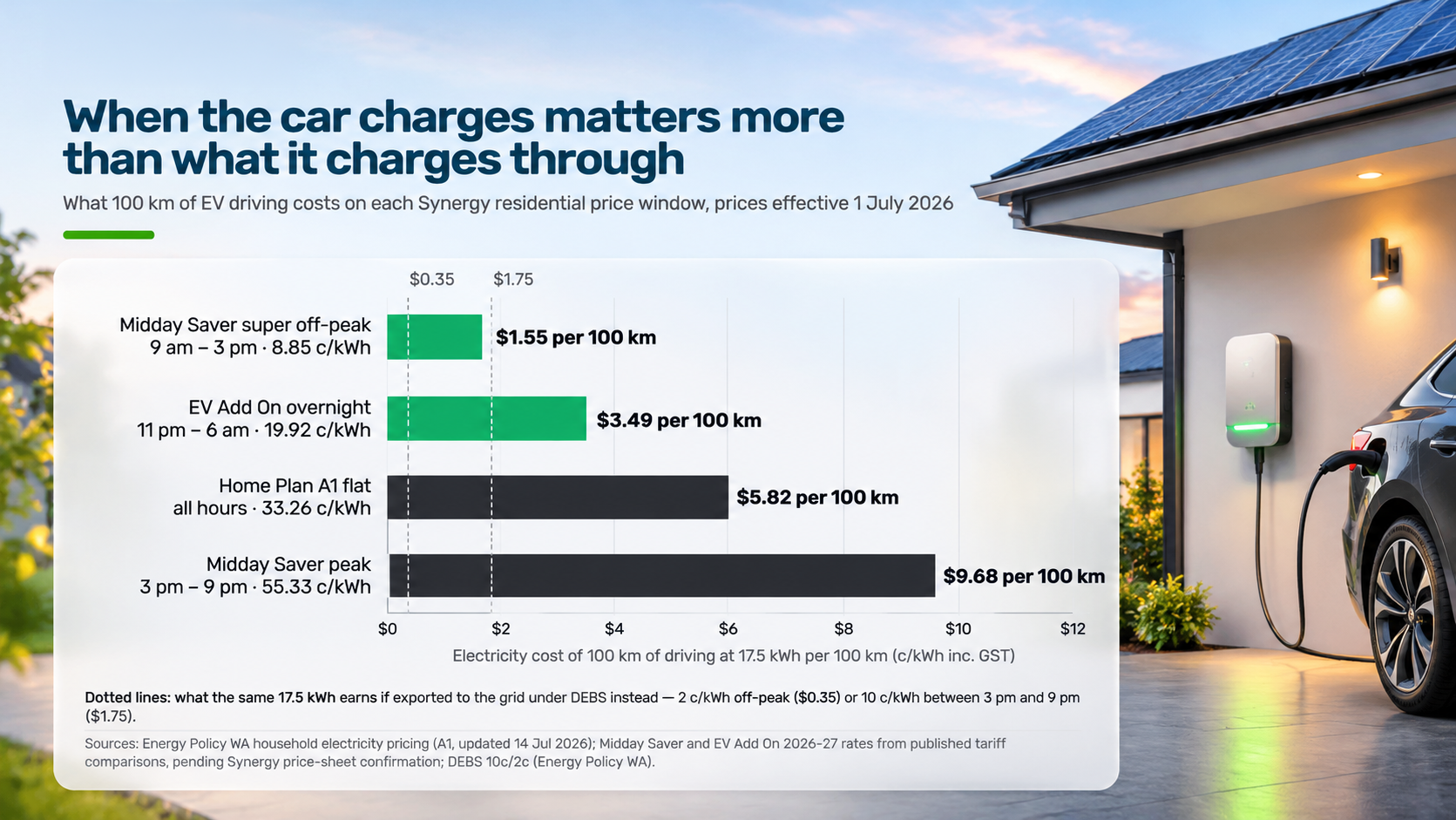
Figure 3. What 100 km of driving costs on each Synergy price window, 2026-27, with the forgone export value for comparison.
For households whose employer reimburses home charging, the Australian Taxation Office's practical compliance guideline sets a shortcut rate of 4.20 cents per kilometre for fringe-benefits years up to 31 March 2026 and 5.47 cents per kilometre from 1 April 2026. A home charging station is not itself a car expense under the exemption; the electricity is.
What the partner hardware can do
We do not recommend a charger brand in an article, because the right unit depends on the car, the inverter and the switchboard. What is worth knowing is that solar-smart and load-managed charging is now standard across the systems Regen Power installs.
- Tesla's Wall Connector delivers 7.4 kW on single-phase or up to 22 kW on three-phase and can share power across up to six units. Since October 2026 its Charge on Solar function works with any make of EV at homes with a Powerwall, not only with Teslas.
- Sigenergy's SigenStor takes a DC charging module of 12.5 kW or 25 kW that charges the car directly from the solar and battery bus, and is bidirectional - the hardware path to vehicle-to-home that we discussed in our V2G article.
- Huawei's FusionCharge AC chargers (7 kW single-phase, 22 kW three-phase) can be set anywhere from 1.4 kW upwards and carry integrated 6 mA DC fault detection, so a Type A RCD suffices.
- GoodWe's HCA series (7, 11 and 22 kW) and Alpha-ESS's 7 kW SMILE charger both integrate with their own energy-management platforms for solar-priority charging and dynamic load control.
- What is the home's supply - single-phase 63 A or three-phase 32 A per phase - and has the maximum demand been calculated with the charger included?
- Is load management specified, and does the charger limit grid import dynamically or by a fixed setting?
- Is the charger's power matched to the car's onboard charger, and is the installation cabled for 32 amps?
- Is the charger on a dedicated final sub-circuit with the correct RCD type?
- Is the main switch a circuit breaker, and if not, is the upgrade in the price?
- Are the consumer mains and switchboard adequate, or is an upgrade required?
- Does the charger integrate with the solar inverter or battery for surplus charging?
- Which Synergy plan is recommended for the household's routine, and does it require a meter change?
- Which notices and the Electrical Safety Certificate will be lodged, and when?
The common thread is a charger that talks to the inverter and the meter. A unit that does neither is a resistive load with a plug on it.
What a compliant Perth quote should include
A home EV charger quote in Western Australia should be able to answer nine questions. If it cannot, ask for a revised one.
The cost drivers follow the same list: cable distance from switchboard to parking bay, switchboard and main-switch work, consumer-mains upgrades on older homes, and whether a connection upgrade is needed at all. The charger itself is usually the smallest variable.
What this means for you
If you are collecting an EV in the next few months: ask your electrician for a maximum-demand assessment first, choose a 7.4 kW load-managed charger unless your car and household need three-phase speed, and pick the Synergy plan around the car's routine rather than around the charger.
If you already charge from a portable cable in a power point: it works, but a 10-amp socket was never designed for eight hours at full load every night. A dedicated circuit and a wall unit are the safe path, and the difference is five hours of charging against twenty-five.
If you have solar and a battery: make solar-smart charging the default and let the battery, not the car, carry the evening peak. A battery drained into a car at 6 pm is doing the car's job at the household's expense.
And if the arithmetic says the house is out of room - two cars, a pool, a fully electric kitchen - read the three-phase decision before signing anything.
Regen Power's perspective
Regen Power has installed more than 45,000 solar, battery and EV charging systems across Western Australia since 2003, with our own electricians under contractor licence EC9676, as a Clean Energy Council Approved Retailer and Tesla Energy Certified Installer. We partner with Tesla, Huawei, Sigenergy, GoodWe and Alpha-ESS, which is precisely why we do not write charger reviews: on most Perth homes the decision is made at the switchboard and the meter, not on the brochure. Our ARC Linkage research with Curtin University on battery sizing and smart charging rests on the same premise - that the value is in when energy moves, not in the box it moves through.
Next step. Book a home energy assessment with Regen Power. Bring a photo of your switchboard, your last Synergy bill and the make and model of the car. We confirm your supply and maximum demand, tell you whether load management or a connection upgrade is the right path, and recommend the plan that fits the car's routine - before any charger is named.