For most of the past twenty years the conversation went like this. A Perth homeowner asked for a bigger solar system, the installer looked at the meter box, saw a single service fuse, and explained that a single-phase home was limited to a 5 kVA inverter - and that anything larger meant converting to three-phase. Many Western Australian households made that decision on that basis.
On 1 May 2026 the basis changed. Under the new Wholesale Electricity Market procedure for standard small user facilities, a single-phase home on the South West Interconnected System may connect up to 30 kVA of aggregate inverter capacity - the same ceiling as a three-phase home. The main reason people converted has largely gone. But three-phase has not stopped mattering; what it decides has moved. It now decides how much load the house can carry, how fast an electric car can charge and - the point almost nobody is told - what a home battery can keep running when the grid goes down. This article is a decision framework for that choice, written for the homeowner rather than the electrician.
How to tell what your home has
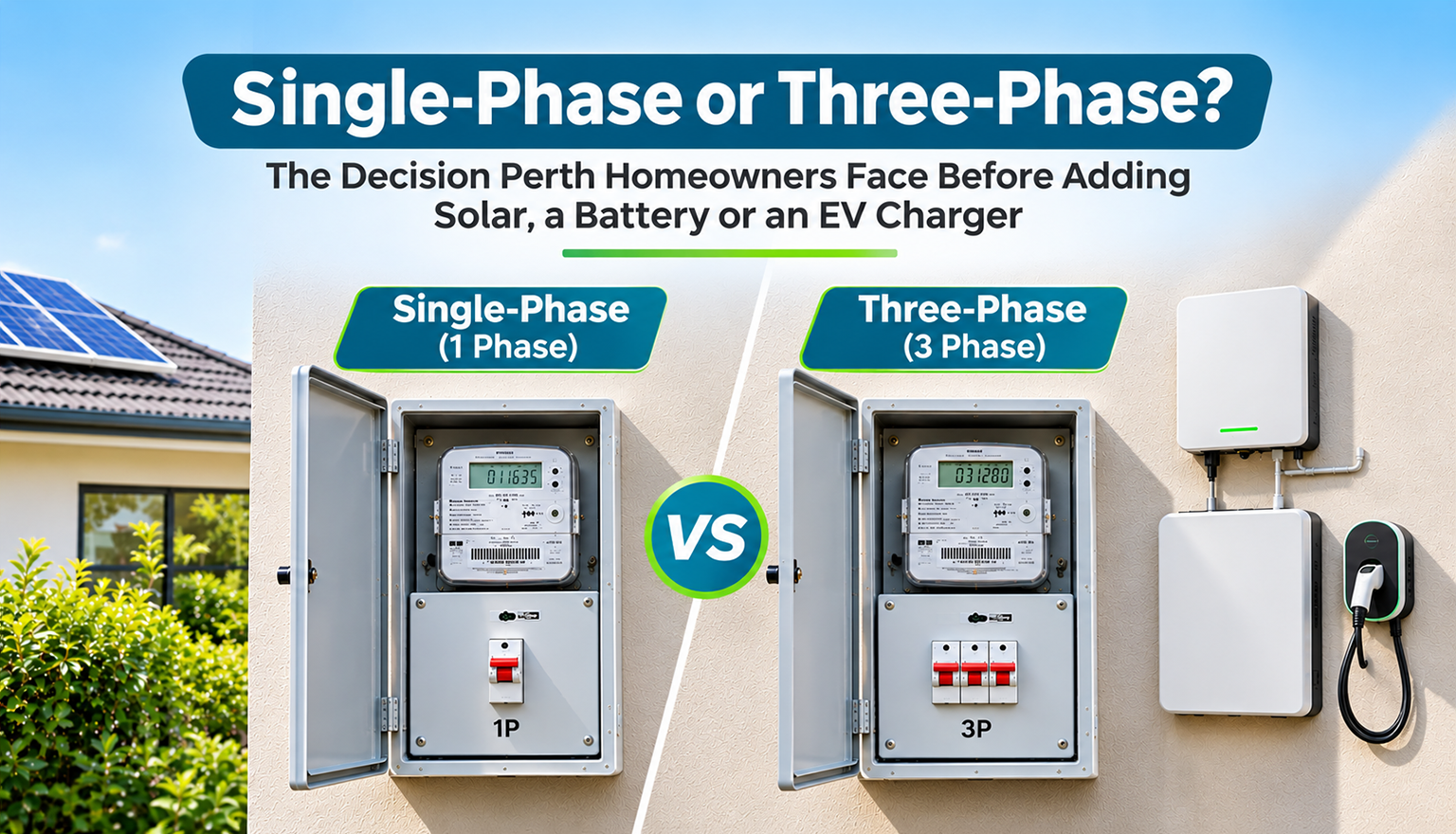
Open the meter box. A single-phase home has one service fuse, or a single-pole main switch, and is supplied at 240 volts; a three-phase home has three, supplied at 415 volts between phases. Western Power's standard connection service - what every home receives without paying for an upgrade - is 63 amps on single-phase or 32 amps per phase on three-phase, a standard that has applied across the SWIS since 11 April 2023, when rural single-phase homes were lifted from 32 to 63 amps. In round numbers that is about 15 kVA of supply capacity on single-phase and about 23 kVA on three-phase, and that ratio matters for everything that follows.
Three-phase is also "subject to service availability". Not every street has it at the pillar or the pole, which is why the first step of any conversion is an availability enquiry rather than a quote.
What changed on 1 May 2026 - and what did not
The 30 kVA cap is the same on both
The WEM Procedure: Technical Requirements for Standard Small User Facilities, published on 29 January 2026 and in force from 8 am on 1 May 2026, sets a single rule at clause 3.1.1: a standard small user facility "must not exceed 30 kVA of aggregate rated IES capacity" - inverter energy systems, meaning solar inverters and battery inverters together. The cap applies equally to single-phase, split-phase and three-phase connections, and Energy Policy WA's guidance to installers confirms it: 30 kVA for both single- and three-phase. Before this, Western Power's basic connection requirements had limited single-phase homes to 5 kVA of inverter capacity (10 kVA with a battery) against 15 kVA for three-phase, with the single-phase figure lifted in stages to 10-15 kVA in the two years before the change.
For a homeowner the implication is direct. A single-phase home can now host a 10 kW hybrid inverter with a battery and a second inverter for an expansion or an EV charger without a phase conversion, where two years ago the same design would have triggered one.

Figure 1. Standard-connection inverter limits before and after 1 May 2026, with the generation limits that still differ by phase.
The generation and export limits are not
The 30 kVA figure is what can be connected. How much of it may generate at once, and how much may be exported, still depends on the phase and on the network behind the house. On Western Power's large 415-volt low-voltage networks - most of metropolitan Perth - a single-phase home has a generation limit of 15 kVA and a three-phase home 8 kVA per phase, or 24 kVA in total. On smaller shared or sole-use networks the limits are 10 kVA and 5 kVA per phase. Capacity above the generation limit must be actively controlled by the inverter to the settings in AS/NZS 4777.1:2024. Export is tighter still: the standard limit is 1.5 kW, and a home may export more - up to 5 kW on a large network or 3 kW on a small one - only if the system can be remotely managed by the network through CSIP-AUS, falling back to 1.5 kW if communications are lost.
| Standard connection, SWIS, from 1 May 2026 | Single-phase | Three-phase |
|---|---|---|
| Standard supply | 63 A at 240 V | 32 A per phase at 415 V |
| Aggregate inverter capacity (solar + battery) | 30 kVA | 30 kVA |
| Generation limit — large LV network | 15 kVA | 8 kVA per phase (24 kVA) |
| Generation limit — small or shared LV network | 10 kVA | 5 kVA per phase (15 kVA) |
| Export — standard | 1.5 kW | 1.5 kW |
| Export — remotely managed (CSIP-AUS) | up to 5 kW (large network) or 3 kW (small) | up to 5 kW (large network) or 3 kW (small) |
| Maximum imbalance from single-phase inverters | — | 3 kVA solar only · 5 kVA with a battery |
Sources: WEM Procedure - Technical Requirements for Standard Small User Facilities v1, clauses 3.1 to 3.4; Western Power Basic EG Connection Technical Requirements, 23 January 2026; Western Power Standard Connection Service Capacity. Confirm the three-phase export maximum per connection against the procedure before publishing (Section E).
Phase balance and the two-per-cent rule
Two technical rules explain why single-phase still has a practical ceiling. The first is phase balance. On a three-phase service, generation must be spread across the phases: a single-phase inverter on a three-phase home may create an imbalance of no more than 3 kVA, or 5 kVA where a battery is included, and a battery with more than 5 kVA of inverter capacity must itself be balanced across all three phases. The second is voltage rise. AS/NZS 4777.1 limits the voltage rise between the point of supply and the inverter's terminals to 2 per cent of nominal; a given kilowatt pushed down one phase draws roughly three times the current per conductor of the same kilowatt spread across three, so single-phase systems reach that limit sooner and, if they breach it, the inverter trips off. These are the reasons a well-designed 15 kW system on a single-phase home is often built from two inverters with export limiting, where a three-phase home would use one.
The four tests where three-phase still matters
With inverter capacity no longer the deciding factor, the case for three-phase rests on four tests. A home that fails none of them should stay single-phase and spend the conversion budget on storage.
Test one: total load
The 63-amp standard connection is a budget, and an all-electric home spends it quickly. Under the maximum-demand method in AS/NZS 3000, cooking appliances count at 50 per cent of their rating and fixed air-conditioning at 75 per cent, but an EV charger counts at 100 per cent. A home with an induction cooktop, a 10 kW ducted reverse-cycle system, a heat-pump hot-water unit and a 32-amp charger exceeds 63 amps on paper. Load management - a smart charger that throttles to keep total import under the limit - solves this for most households, as our companion article on EV charger installation explains. It stops solving it when the loads that need managing are not flexible: two cars that both need to charge after a late return, a pool heat pump that runs through the evening, a workshop.
Test two: EV charging speed
A single-phase charger delivers up to 7.4 kW; three-phase allows 11 kW or 22 kW. But the car sets the ceiling - any EV that charges at 11 kW or more has a three-phase onboard charger, and many popular models in Australia do not. Against a WA average of about 34 kilometres a day, 7.4 kW restores a day's driving in under an hour. Three-phase charging speed is a reason to convert only for a household with two EVs and a short overnight window, or a car that regularly arrives near empty and must leave full.
Test three: backup
This is the test most homeowners never hear about until after the battery is installed. A single-phase battery - Tesla's Powerwall 3 is the best-known example - works perfectly well on a three-phase home, but during a blackout it can supply only the phase it is connected to. If the kitchen is on one phase and the battery on another, the kitchen is dark. A three-phase home that wants whole-house backup has two options: a three-phase hybrid battery inverter that supports all three phases, or one single-phase unit on each phase, which backs each phase up separately but not as a synchronised three-phase supply. The single-phase home has the simpler life here: one battery, one phase, the whole house.
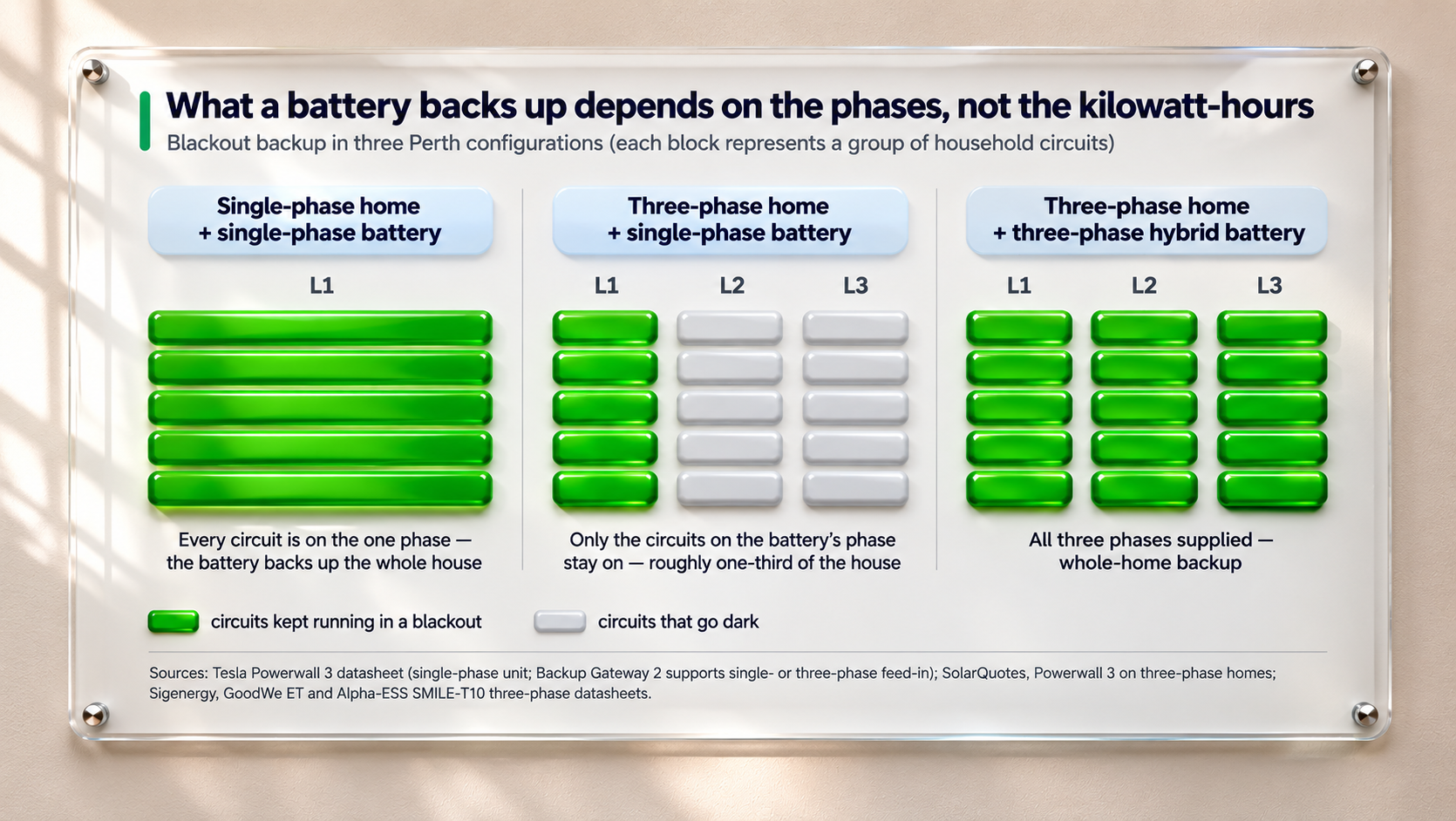
Figure 2. What a battery keeps running in a blackout depends on how the phases and the battery line up.
Test four: large single appliances
Some loads are three-phase by nature. Air-conditioner manufacturers reserve three-phase models for their larger ducted capacities; large pool and spa heat pumps, lifts, some workshop machinery and 22 kW EV chargers are three-phase only. A household that already owns one of these has already made the decision.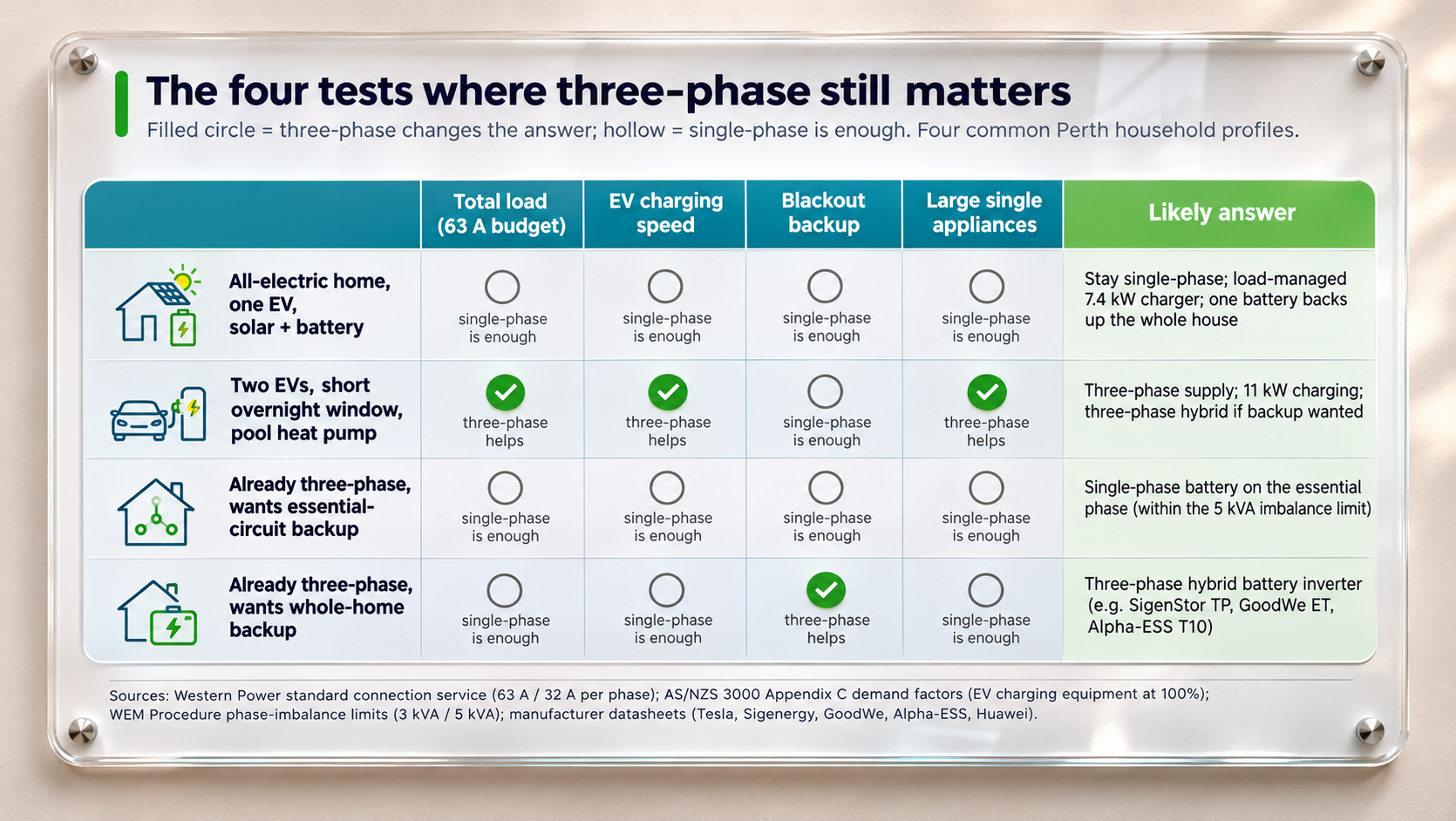
Figure 3. Four household profiles against the four tests, and the path each one points to.
The battery question on a three-phase home
Because backup is where phases bite, it is worth setting out what the systems Regen Power installs can do, as capability rather than recommendation.
- Tesla Powerwall 3 is a single-phase 13.5 kWh unit with grid output configurable at 5, 10 or 11.04 kW. The Backup Gateway 2 supports single- or three-phase feed-in, and a Powerwall on a three-phase home backs up the phase it sits on. Up to four units can be combined, and one per phase with separate gateways gives per-phase backup.
- Sigenergy SigenStor comes in single-phase (3–12 kW) and three-phase (5–30 kW) controllers with battery modules of 5.2 or 7.8 kWh usable, up to six per stack, and a three-phase gateway rated to 30 kW for whole-home or partial backup.
- Huawei LUNA2000 pairs with single-phase (2–6 kW) or three-phase (3–10 kW) hybrid inverters, with 5 kWh modules to 15 kWh per stack and 30 kWh in total; its backup boxes provide single-phase backup output of 5 kVA or 3.3 kVA.
- GoodWe EH single-phase hybrids (3.6–6 kW) and ET three-phase hybrids (5–10 kW) both provide backup, with the ET series rated for fully unbalanced output across phases.
- Alpha-ESS offers the SMILE5 single-phase system and the SMILE-T10 three-phase system with three-phase backup, in 8.2 kWh modules to 49.2 kWh.
Two design rules follow. On a three-phase home, put a single-phase battery on the phase that carries the circuits you most want to keep - refrigeration, communications, a medical device, one living area - and have the electrician move circuits if needed. The phase-balance limits above cap how much battery inverter capacity may sit on one phase, which in practice means a single-phase battery on a three-phase service is usually configured to 5 kVA of grid output. And if whole-home backup is the goal, choose a three-phase hybrid at the outset rather than adding units later.
The question to ask before a battery is quoted on a three-phase home is not "how many kilowatt-hours" but "which phase, and what is on it".
Converting to three-phase in WA: the process, and the alternative
A phase conversion in the Western Power network is a contractor-led process. The homeowner or electrician first lodges an enquiry to confirm that three-phase is available at the property. A registered electrical contractor then submits the phase-conversion application with the existing meter number and lodges a preliminary notice before any work, and Western Power quotes five to seven weeks from confirmed availability to disconnect and reconnect. On the house side the job typically includes new consumer mains, a new or rebuilt switchboard with a three-pole main circuit breaker, and metering changes; Western Power's advanced-meter rollout, which is due to cover more than 1.2 million meters by mid-2027, means most conversions now receive an advanced meter as a matter of course.
Western Power publishes a fixed fee for the conversion that differs for overhead and underground supplies; the house-side electrical work is the larger and more variable cost, and it is where quotes diverge.
The alternative is to stay single-phase and design around the 63 amps: a 30 kVA inverter ceiling is enough for any residential solar-and-battery system, load management handles the EV charger, and one single-phase battery backs up the whole house. For the majority of Perth homes with one electric car, this is now the better answer.
A decision framework, with a Perth example
| Your situation | Likely answer | Why |
|---|---|---|
| Single-phase, adding solar and a battery | Stay single-phase | The 30 kVA cap now applies to you; one battery backs up the whole house |
| Single-phase, adding one EV charger | Stay single-phase, load-managed 7.4 kW charger | Western Power permits it within maximum demand; a day's driving is restored in under an hour |
| Single-phase, two EVs plus a pool heat pump and large ducted air-conditioning | Consider three-phase | Inflexible loads exceed 63 A; 11 kW charging for two cars |
| Already three-phase, wants a battery with essential-circuit backup | Single-phase battery on the essential phase | Simpler and cheaper; stays within the 5 kVA imbalance limit |
| Already three-phase, wants whole-home backup | Three-phase hybrid battery inverter | The only route to all three phases from one system |
| Street has no three-phase available | Stay single-phase, design to 63 A | Conversion is not possible; load management and export control do the work |
Consider a four-bedroom home in Perth's northern suburbs on a standard 63-amp single-phase supply, planning a 10 kW hybrid inverter, a 13.5 kWh battery, a 7.4 kW EV charger, an induction cooktop, a 10 kW ducted system and heat-pump hot water. On the maximum-demand arithmetic the charger pushes the home a few amps over 63; with dynamic load management the charger yields to the air-conditioner on summer evenings and recovers the car overnight. The battery carries the 3 pm to 9 pm peak. Export sits at 1.5 kW unless the system is remotely managed, which is why the design prioritises self-consumption. The whole house is backed up by the one battery. There is no phase conversion in that design. Add a second EV and a pool heat pump to the same house, and there is.
What this means for you
If you are single-phase and planning solar and a battery: the inverter-capacity reason to convert has gone. Design to 30 kVA, accept that export above 1.5 kW requires a remotely managed system, and keep the conversion budget for storage.
If you are single-phase and adding an EV charger: a load-managed 7.4 kW unit fits a standard connection for most households. Convert only if the four tests say so.
If you are already three-phase and want a battery: decide what backup means to you before anyone quotes kilowatt-hours. Essential circuits on one phase is a single-phase battery placed well; the whole house is a three-phase hybrid.
If you are building or renovating: three-phase is cheapest to specify before the slab is poured, and the decision should be made on the four tests, not on habit.
Regen Power's perspective
Regen Power has designed and installed more than 45,000 solar, battery and EV charging systems across Western Australia since 2003, with our own electricians under contractor licence EC9676, as a Clean Energy Council Approved Retailer and Tesla Energy Certified Installer. We install single- and three-phase systems from Tesla, Huawei, Sigenergy, GoodWe and Alpha-ESS, which means we have no stake in which phase a customer ends up on - only in whether the design matches the house. Our ARC Linkage research with Curtin University on battery sizing sits downstream of this decision: a battery sized perfectly for a household's load profile still backs up the wrong rooms if the phase question was skipped.
The rule in our practice is simple. We design to the supply the house has before we propose changing it, and when we do recommend a conversion, we can name which of the four tests it passed.
Next step. Book a home energy assessment with Regen Power. Bring a photo of your meter box and switchboard, your last Synergy bill and a list of what you plan to add - solar, storage, a car, a pool. We confirm your phase and supply capacity, run the four tests, and tell you whether to stay single-phase, place a battery on the right phase or convert - before any equipment is named.