On the evening of Saturday 9 May 2026, grid-scale batteries supplied 37.2 per cent of peak demand on the South West Interconnected System - one of the highest storage shares ever recorded on an isolated grid, with most of that capacity sitting in two batteries at Collie. The same physics now operates at the scale of a warehouse, a medical practice or a cold-storage shed. What is less understood is that the rules deciding whether a battery pays for a Western Australian business are different from anything written for the east coast.
Most commercial battery advice published in Australia is written for the National Electricity Market, where a business can usually earn a feed-in tariff, choose among dozens of retailers and face broadly similar network charges. None of that transfers cleanly to the SWIS. This article sets out the three numbers that actually decide the question for a Perth business, and the 2026 changes that have moved all three.
Why the question has changed in 2026
Five things happened between May and October 2026 that a business evaluating storage should know about.- Wholesale prices rose sharply. AEMO's Quarterly Energy Dynamics for the June 2026 quarter put the average Wholesale Electricity Market price at $118/MWh, up 30 per cent on a year earlier, as lower wind and coal output pushed the system onto gas. Wholesale is not what a business pays, but it is what contestable contracts are built on.
- Regulated business tariffs rose on 1 July 2026. The R1 time-of-use peak rate moved from 42.0178 to 43.1733 cents per unit, with increases of roughly two to three per cent across the small-business tariffs.
- The federal battery discount applies to businesses, and it steps down on 1 January 2027. Despite its name, the Cheaper Home Batteries Program discounts the first 50 kWh of usable capacity at a business premises. The certificate factor falls from 6.8 to 5.7 per kWh for installations from 1 January 2027, and to 5.2 from 1 July 2027.
- The small-scale solar scheme now reaches 1 MW. From 1 October 2026, rooftop systems between 100 kW and 1 MW earn upfront small-scale technology certificates under the Mid-scale Solar Regulations 2026, instead of accruing large-scale certificates over time.
- The $20,000 instant asset write-off is now permanent. The Treasury Laws Amendment (Tax Reform No. 2) Act 2026 received assent on 26 August 2026, fixing the per-asset threshold for businesses with turnover under $10 million from 1 July 2026.
The three numbers that decide it
Strip away the product brochures and a commercial storage decision in WA reduces to three quantities. Two of them are set by the state; the third depends on where your site sits relative to the 50 MWh a year contestability line.Number one: your tariff spread
A battery earns its keep by moving energy from a cheap hour to an expensive one. The size of that gap - the spread - is the first number. In the SWIS, businesses using 50 MWh a year or less are supplied by Synergy at government-regulated tariffs. Above 50 MWh a site is contestable and can negotiate with any licensed retailer; between 50 and 160 MWh it may instead take Synergy's capped contestable tariff. The regulated rates from 1 July 2026 are published by Energy Policy WA:| Tariff (Synergy, SWIS) | Who it is for | Rate from 1 July 2026 (c/unit inc. GST) | Supply charge |
|---|---|---|---|
| L1 Business Plan (flat) | Non-contestable, ≤50 MWh/yr | First 1,650 units/day 33.1278; above 37.3504 | $2.1288/day |
| R1 Business Time of Use | Non-contestable, ≤50 MWh/yr | Peak (8am–10pm weekdays) 43.1733; off-peak 12.9518 | $3.9806/day |
| L3 Business Plan Fifty (flat) | Contestable, capped tariff | First 1,650 units/day 38.9075; above 33.0144 | $1.9155/day |
| R3 Business Time of Use Fifty | Contestable, capped tariff | Peak 61.1662; off-peak 18.3744 | $4.1933/day |
Source: Energy Policy WA, Business and Government Electricity Pricing, rates effective 1 July 2026. Rates are rounded at the fourth decimal; confirm the exact figure with Synergy.
The spreads are the point. On R1 the gap between peak and off-peak is about 30 cents a unit; on R3 it is close to 43 cents. For comparison, the residential Midday Saver tariff has a wider gap but only a six-hour peak. R1's peak window runs fourteen hours on weekdays, which cuts both ways: there are more expensive hours to displace, but a battery charged from a day's solar can only cover some of them. For a business that closes at five, the battery's job is the morning ramp and the early evening. For an evening operator, it is the whole evening.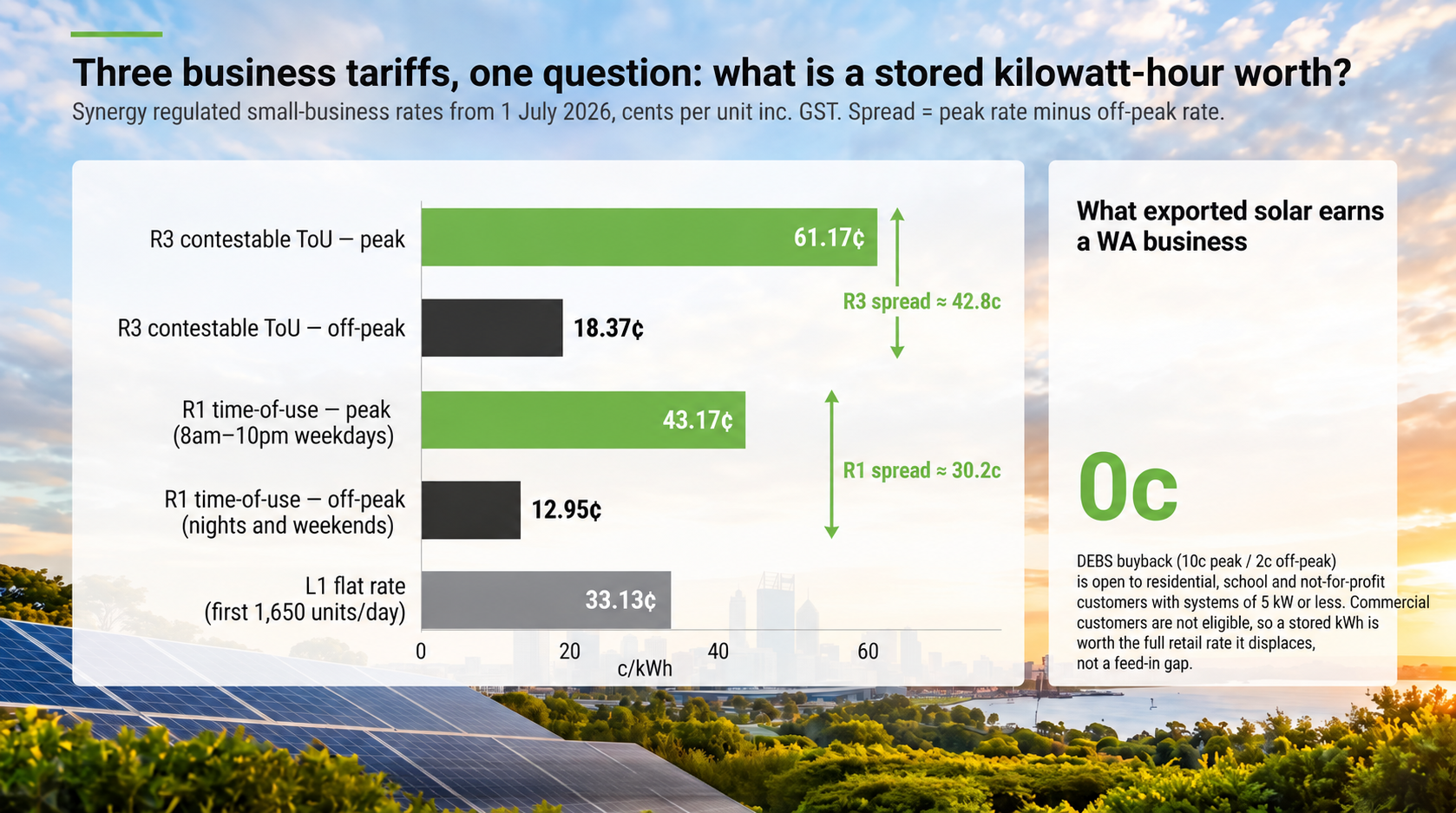
Number two: what your exported solar is worth
This is the number most east-coast guides get wrong for WA. The Distributed Energy Buyback Scheme pays 10 cents a unit for exports between 3pm and 9pm and 2 cents at other times — but it is open to residential customers using no more than 50 MWh a year, to schools and other educational institutions, and to non-profit organisations, with systems between 500 W and 5 kW. Commercial customers are not among the eligible groups. A contestable site can sometimes negotiate export terms with its retailer, but they are rarely generous.
The consequence is decisive. At a typical Perth business, every kilowatt-hour of midday solar that leaves the site is given away, so a stored kilowatt-hour is worth the full retail rate it displaces - 33 to 61 cents depending on the tariff - rather than the gap between a feed-in tariff and retail. This is the single biggest reason the storage case is structurally stronger for WA commercial sites than for WA households, where DEBS and the state rebate change the arithmetic.
The connection rules reinforce it. Since 1 May 2026, new or upgraded inverter systems in the SWIS must be remotely manageable by the network or accept a fixed 1.5 kW export limit. The network is not looking for more midday export; it is looking for load that can absorb it, and a commercial battery is exactly that.
Number three: your demand-charge exposure
Businesses on the regulated L1 and R1 tariffs do not see a demand charge, so for them this number is zero. The moment a site becomes contestable, however, its retailer passes through Western Power's network charges, and several of those reference tariffs bill on demand measured in kVA rather than on energy alone. The RT5 and RT6 metered-demand tariffs charge on the highest 30-minute demand recorded over a rolling twelve-month period, with the rate stepping at 300 kVA and 1,000 kVA. The newer RT36 super off-peak demand tariff for small business, introduced in the current access arrangement, charges on the maximum 30-minute demand inside the 3pm to 9pm on-peak window within each billing period.
A battery that shaves a site's peak lowers that charge directly, and on a billing-period tariff the saving is immediate. On a rolling twelve-month tariff the logic is harsher: one missed peak - a compressor and a lift starting together on a 40-degree afternoon - sets the charge for the following year. For demand-charge sites, the control software that decides when the battery holds its reserve matters more than the cell chemistry inside it.
“A useful rule of thumb: if you can name your network tariff code and your highest kVA reading in the past twelve months, you are already most of the way to knowing whether a battery should be sized in kilowatts (to shave demand) or in kilowatt-hours (to shift energy).”
The federal battery discount works for businesses too
The Cheaper Home Batteries Program is delivered through small-scale technology certificates, which an accredited installer claims and passes on as a point-of-sale discount. The rules that matter for a business are these:- The claim can be made by an individual, a business or a body corporate, and the premises can be commercial. Only one battery per premises is eligible, and an expansion must add at least 5 kWh.
- The battery must have between 5 and 100 kWh of nominal capacity, but the discount applies only to the first 50 kWh of usable capacity.
- It must be connected to a new or existing rooftop solar system, be VPP-capable (joining one is not required), and use a battery and inverter on the Clean Energy Council approved lists, installed by an SAA-accredited installer.
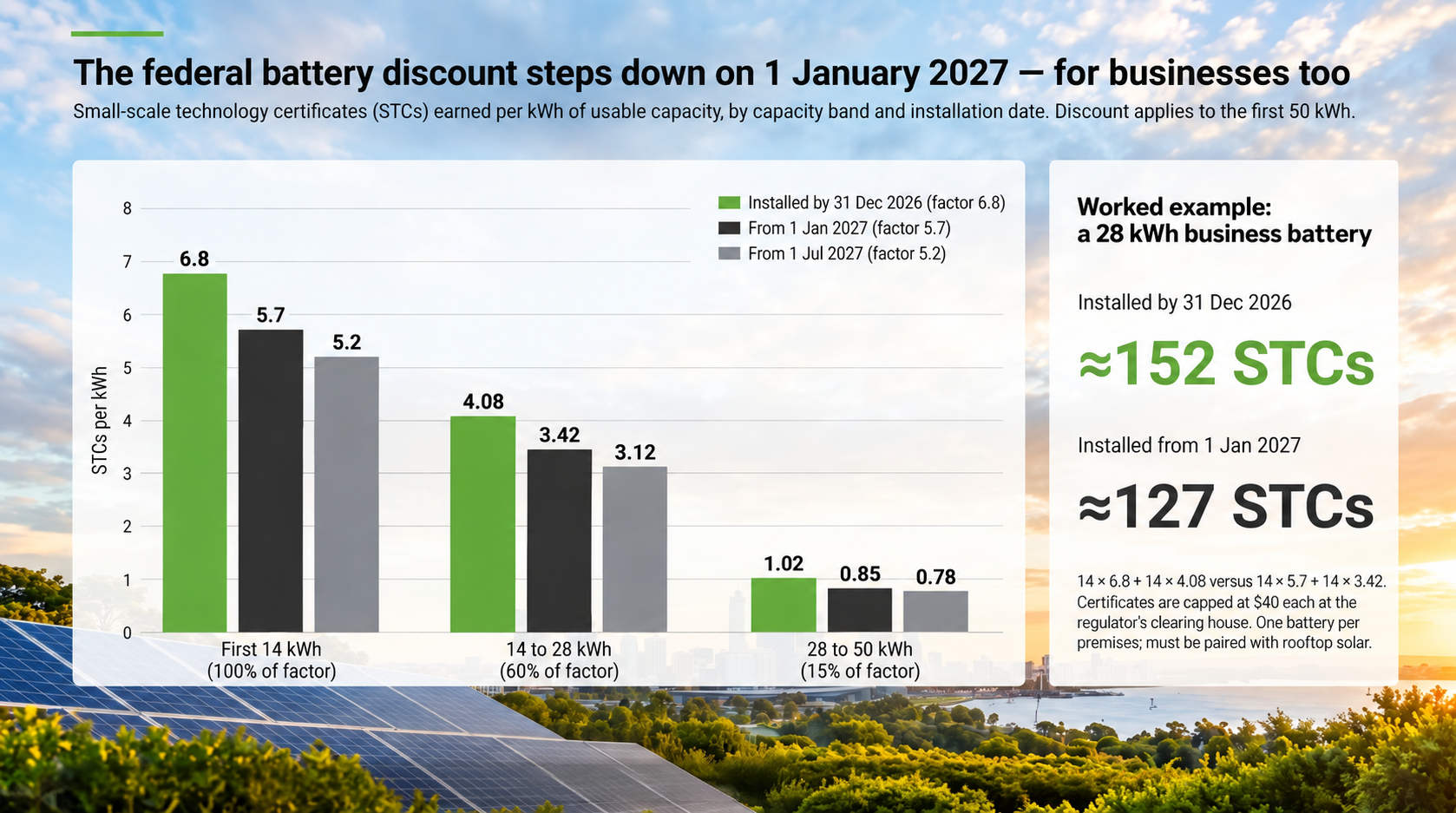
- Since 1 May 2026, the certificate factor is tiered by size: 100 per cent of the factor on the first 14 kWh, 60 per cent from 14 to 28 kWh, and 15 per cent from 28 to 50 kWh.
- The factor is 6.8 certificates per kWh for installations to 31 December 2026, 5.7 from 1 January 2027 and 5.2 from 1 July 2027, stepping down every six months to 2030. Certificates trade at up to $40 each through the regulator's clearing house, and the installation date — not the contract date — is what counts.
Worked through, a 28 kWh business battery installed in December earns roughly 152 certificates; the same unit installed in January earns roughly 127. That is a real difference, but it is about 16 per cent of the discount on a system that should be chosen for a ten-year load profile. It is a reason to finish a project that is ready, not a reason to install the wrong one.
Two things the federal programme does not do: it does not combine with the WA Residential Battery Scheme at a business premises, because the state rebate is residential only; and it does not reach beyond 50 kWh, so the case for larger commercial storage has to stand on the three numbers above without help.
Which Perth businesses the numbers favour
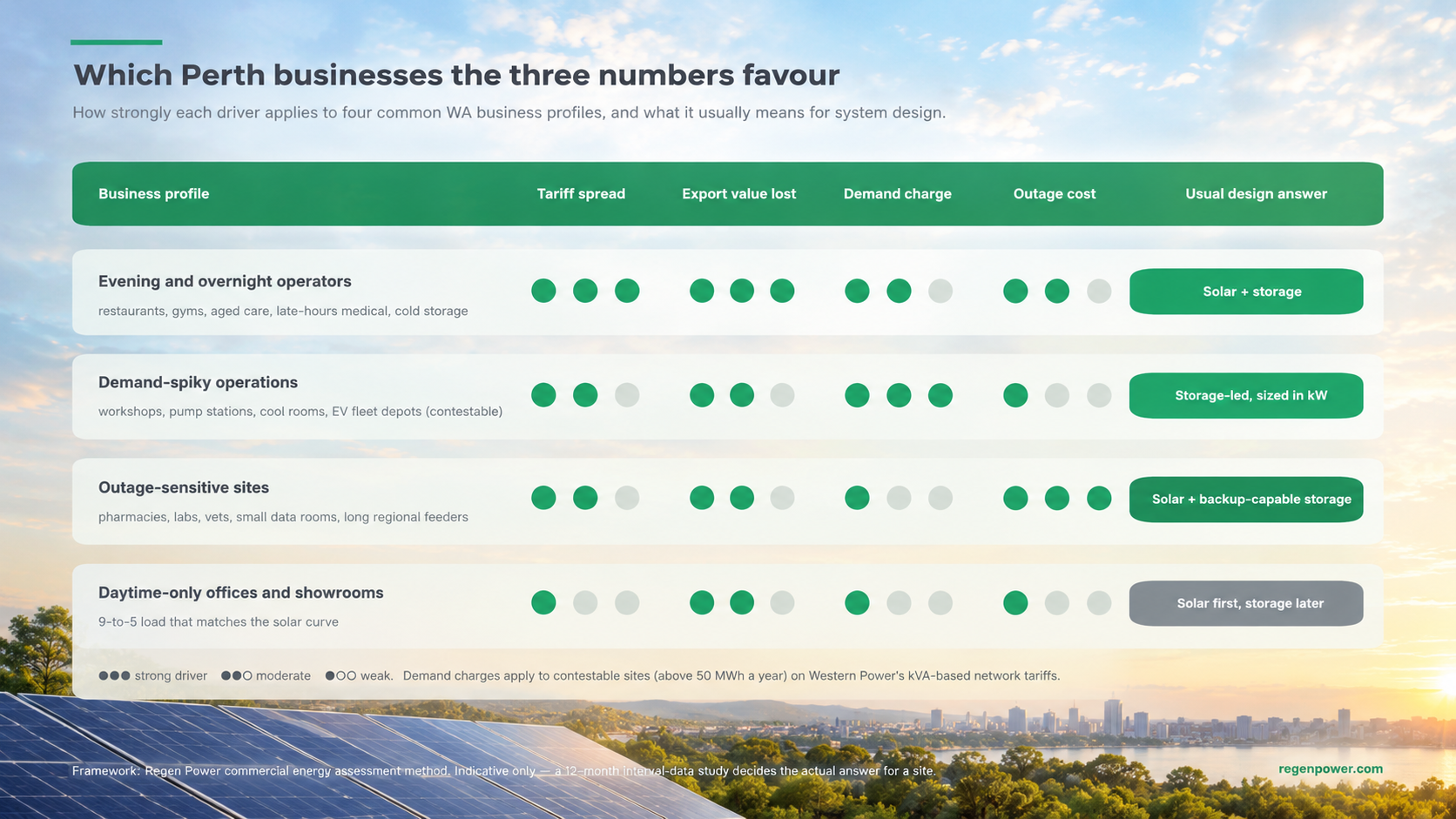
Put the three numbers together and four business profiles fall out. They are not the only ones, but they cover most of the enquiries our commercial team receives.- Evening and overnight operators — restaurants, gyms, aged care, late-hours medical practices, and cold storage with overnight compressors. Solar fills the battery at midday and the battery carries the 4pm to 10pm peak. This is the strongest case in the state.
- Demand-spiky operations — workshops with welders and compressors, pump stations, cool rooms, and EV fleet depots. For contestable sites, the money is in kVA shaving, and the battery is sized in kilowatts rather than kilowatt-hours.
- Outage-sensitive sites — pharmacies with cold-chain stock, laboratories, veterinary clinics, small server rooms, and regional businesses at the end of long feeders. The value is on the profit-and-loss statement rather than the tariff, and it needs an inverter configuration designed to island the site safely.
- Daytime-only offices and showrooms — nine-to-five loads that match the solar curve. With no export value, the right first move is to size solar to the load; storage becomes compelling when EV charging, electrified hot water, or after-hours HVAC change the profile.
Sizing a commercial battery is a load-profile exercise, not a roof-space one
Residential batteries are often chosen by product line; commercial batteries should be chosen by data. Three principles guide our designs.- Start with twelve months of 30-minute interval data. The shape of the load matters more than its annual total: how many kilowatts need to be carried, and for how many hours after the sun drops. The first sets the inverter; the second sets the storage.
- Let the load set the size, then let the tiers set the cost. A system sized to a certificate band rather than to the evening load will either sit idle or run flat every night. AEMO notes that WA's evening peak is becoming longer and flatter as more batteries come online — the trend that pushed its preferred grid-scale duration from six hours to seven — and commercial storage should be read against it.
- Design to the standards and the connection from day one. AS/NZS 5139 governs battery systems from 1 kWh to 200 kWh, including location, clearances and enclosures. Western Power's standard connection now covers up to 30 kVA of inverter capacity, a conditional exemption covers commercial solar from 30 to 200 kVA with AS/NZS 4777.1:2020 inverters, and anything larger needs a negotiated connection. Phase balance, remote manageability and metering are settled before the switchboard is touched.
What this means for your business
If your site uses 50 MWh a year or less, the first question is whether you are on the right regulated tariff: R1 rewards a business that can push load into nights and weekends; L1 rewards one that cannot. Request your interval data, size solar to the daytime load, and model a battery against the morning and evening shoulders. If you trade in the evening, expect the storage case to be strong.
If your site is contestable, your retailer contract and your Western Power network tariff decide the outcome together. Ask for the network tariff code and the highest kVA demand of the past twelve months before anyone quotes a battery; if the demand charge is a large share of the bill, the battery is a peak-shaver first and an energy-shifter second.
And for everyone: the 1 January 2027 step in the federal discount is worth completing a ready project for, but it is not worth compressing the design work that decides whether the project should exist.
Regen Power's perspective
Regen Power has designed and installed energy systems in Western Australia since 2003 - more than 45,000 of them, from Perth rooftops to off-grid microgrids of up to a megawatt for mining, agriculture and government sites. Our commercial work is done by in-house electricians under contractor licence EC9676, as a Clean Energy Council Approved Retailer and Tesla Energy Certified Installer. Through the ARC Linkage project we lead with Curtin University, we are also building the AI-driven load-profiling and battery-sizing methods that commercial storage design depends on.
That research background shapes a simple rule in our commercial practice: we would rather tell a daytime-only office that storage does not pay yet than install a battery that sits idle. The three numbers decide, and we show the working.
“Next step. Book a commercial energy assessment with Regen Power. Bring twelve months of interval data (or authorise us to request it from your retailer), your last four bills showing the tariff code, and your opening hours. We model solar-only against solar-plus-storage on the actual 2026-27 tariffs and tell you which of the three numbers dominates your site - before any product is named.”