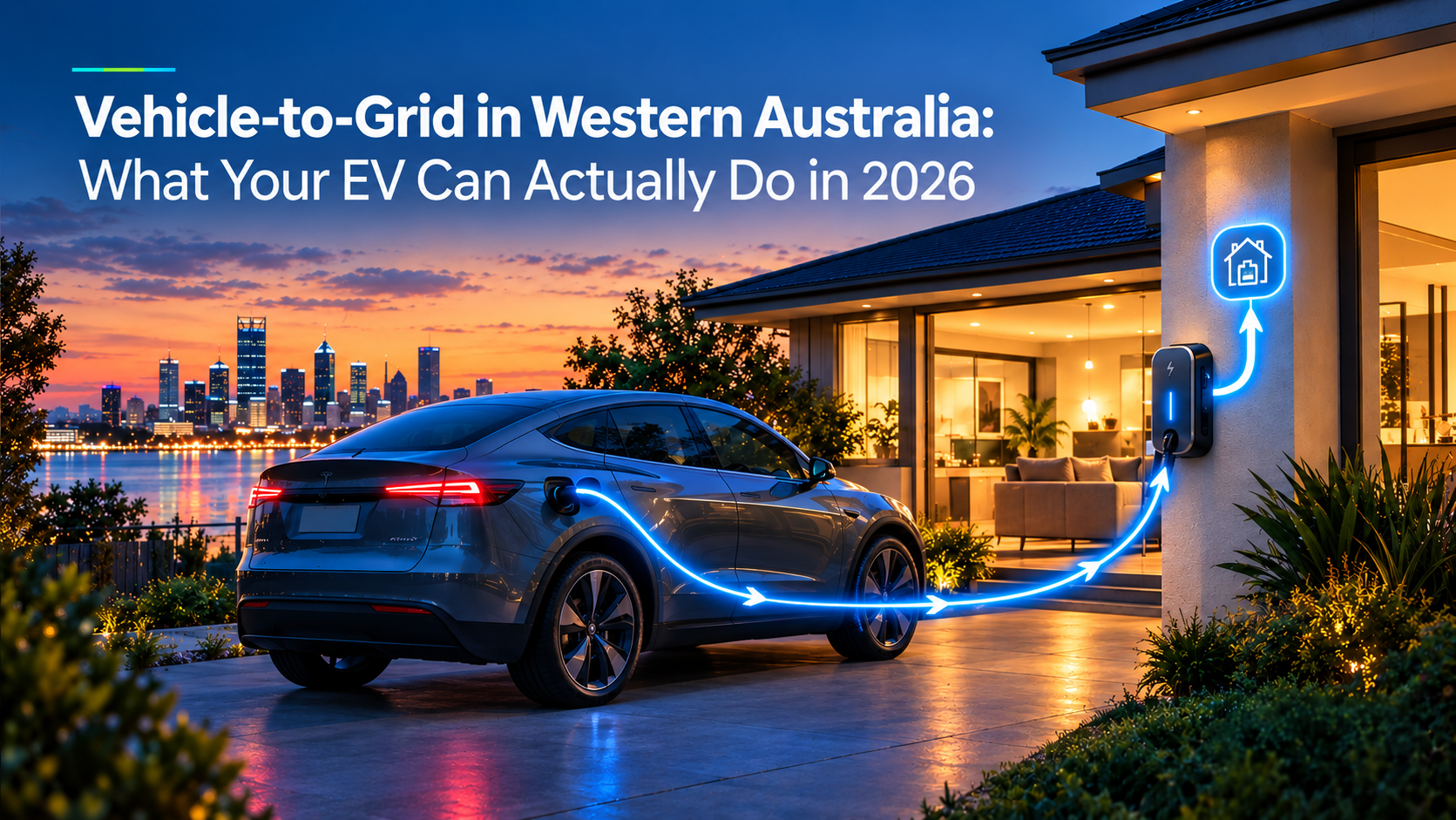
Vehicle-to-grid in Western Australia, assessed honestly: which EVs qualify, what Western Power requires, and the warranty clause buyers miss.
There is a version of the electric vehicle story in which the car in your garage is also the largest battery you own - sixty to eighty kilowatt hours of storage that runs the house through the evening peak and sells the surplus back to the grid. It is a good story. It is also, for the overwhelming majority of Western Australian households in 2026, not yet a purchasable one.
On 19 August 2026, CarsGuide reported that most manufacturers selling electric vehicles in Australia - Hyundai, Kia, BYD, Tesla and Zeekr among them - warn that using unapproved bidirectional charging equipment carries warranty implications. Hyundai's stated position is that none of its vehicles support vehicle-to-grid in Australia. That single sentence is more useful to a WA buyer than any charger comparison table, and it appears in almost none of them.
This is not an argument against V2G. It is an argument for understanding what has to be true before it works, so that a household spending money in 2026 spends it on the right thing.
Three different technologies wear the same label
Much of the confusion is vocabulary. Three distinct capabilities get marketed as bidirectional charging, and they are not interchangeable.
| Capability |
What it does |
Where it stands in WA |
| V2L - vehicle to load |
A domestic power outlet on the car. Runs a fridge, tools, or a camp site. |
Widely available today on several models. No network approval, no installer, no complication. |
| V2H - vehicle to home |
The car powers the house through a bidirectional charger, islanded from the grid. |
Technically achievable with specific charger and vehicle combinations. Requires a compliant installation and, in most configurations, network notification. |
| V2G - vehicle to grid |
The car exports to the grid and can be paid for it. |
The genuinely constrained case. Requires network approval, a listed charger, an approving manufacturer and a retailer product that pays for the export. |
A salesperson describing a car as bidirectional is often describing V2L. It is a real and useful feature. It is not the same as running your Perth home through the evening peak on car storage.
The four gates a WA vehicle-to-grid setup has to pass
Gate one: the vehicle
Hardware capability and manufacturer approval are different things. Several vehicles sold here contain the electronics to export, including the Nissan Leaf, Hyundai Ioniq 5, Kia EV6 and Mitsubishi Outlander PHEV. Fewer permit it under warranty in the Australian market. Mitsubishi is among the few actively supporting V2G within warranty on the Outlander PHEV, while noting that frequent high-rate cycling will reduce battery capacity over time.
The question to put to a dealer, in writing, is not "is this car bidirectional". It is: "does exporting energy from this vehicle through a third-party charger affect the traction battery warranty?"
Gate two: the charger
A grid-connected bidirectional charger is, in regulatory terms, an inverter. AS/NZS 4777.2:2020 Amendment 2:2024 took effect on 23 August 2025, and non-compliant products were removed from the Clean Energy Council's approved inverter list at that point. Wall-mounted, inverter-controlled bidirectional systems are covered by that listing. Vehicle-controlled systems remain under review for listing scope.
Products marketed as V2G-ready are not the same as products that are listed and operating. Several units in the Australian market today are pre-order, staged release, or ready-for-a-future-firmware-update. That is a legitimate commercial position for a manufacturer. It is a poor basis for a household to pay a premium now.
Gate three: the network
This is the gate most national articles omit entirely, and it is the one that applies specifically to Western Australia. Western Power treats a bidirectional EV charger as embedded generation. That means it must meet the Basic Embedded Generator Connection Technical Requirements, and it means an Embedded Generation Connection application must be submitted and approved in writing before anything is connected to the network.
Western Power also advises confirming with the supplier that the equipment is registered with the Clean Energy Council and considered compliant with its network - and warns that the existing connection service may need upgrading to carry the additional load. On an older Perth lot with a single-phase supply and a full switchboard, that is not a trivial line item.
Gate four: the tariff
Even with a compliant car, a listed charger and network approval, the economics depend on what you are paid for exported energy and when. WA households export under the Distributed Energy Buyback Scheme, which pays materially more in the evening window than at midday - a structure that suits storage well in principle.
The practical difficulty is that the vehicle has to be plugged in at home during that window to participate, which for many households is precisely when it is not. A wall-mounted battery is home every evening. That is not a small advantage; it is most of the advantage.
_The constraint on vehicle-to-grid in Perth is rarely the technology. It is that four independent parties - the manufacturer, the charger maker, the network and the retailer - all have to say yes, and in 2026 they do not.
What this means for a Perth household deciding now
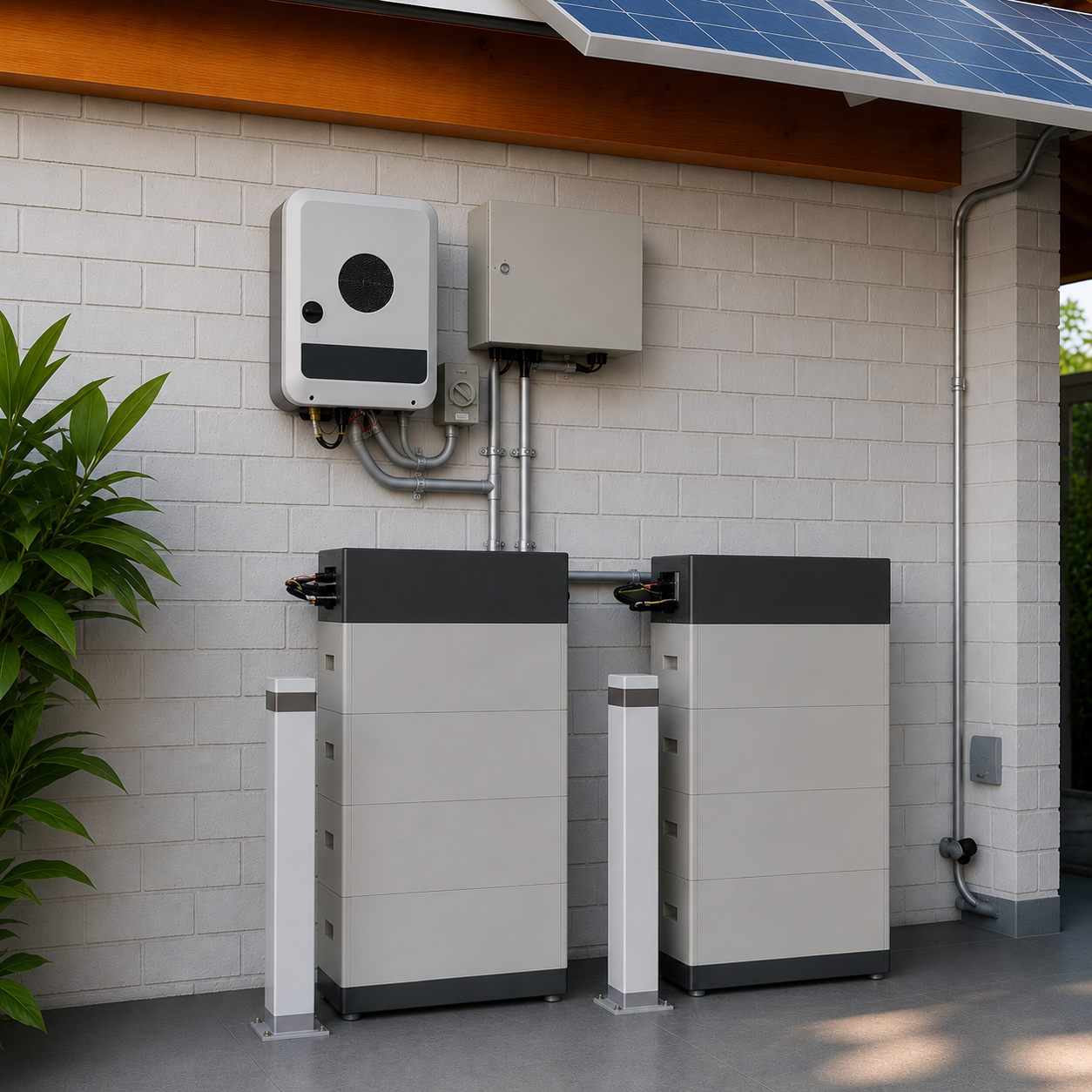
Set the enthusiasm aside and the arithmetic is fairly clean. A household weighing a battery against waiting for V2G is comparing a system that is available, eligible for the federal battery discount, network-approved as routine, and present in the house every evening, against a capability that currently fails at least one of the four gates for nearly every vehicle on sale.
There is also a point about asset value that gets little attention. A home battery is a purpose-built storage asset with a warranted throughput. An EV traction battery is the single most expensive component of a vehicle you intend to resell. Cycling it nightly to arbitrage a tariff spread is a trade with real costs on the other side of the ledger, and manufacturers' warranty language reflects exactly that concern.
None of which argues for ignoring V2G. It argues for sequencing. The households that will benefit first are the ones whose electrical infrastructure is ready when the gates open.
How to be V2G-ready without paying for a promise
- Leave physical space and switchboard capacity at the garage wall when you install solar or a battery now - the marginal cost at build time is small.
- Run a spare conduit from the switchboard to the intended charger position while walls or trenches are already open.
- If you are upgrading the connection for any other reason, ask what a future bidirectional charger would require, and specify to that.
- Choose a battery and inverter platform whose manufacturer has a credible bidirectional roadmap, rather than one that promises firmware.
- Ask your next vehicle's dealer the warranty question in writing before purchase, not after.
That approach costs very little and preserves the option. Paying a premium today for hardware that cannot legally export on your network, in a car whose manufacturer will not warrant the practice, does not.
Where Regen Power sits on this
We install EV charging, solar and battery storage across Western Australia, and we have delivered more than 45,000 systems in this state. Our current research programme with Curtin University, funded through a $1.93 million Australian Research Council Linkage project, is specifically concerned with battery sizing, usage profiling and lifecycle - including how cycling behaviour affects the useful life of a storage asset. That work makes us cautious about advising anyone to treat a vehicle traction battery as household infrastructure before the manufacturers themselves will.
Our position is straightforward. Vehicle-to-grid will matter in Western Australia. It does not yet, for most homes. Build the readiness in now; buy the capability when the four gates actually open.
_If you are planning an EV, a charger or a battery in the next twelve months, talk to a Regen Power consultant about sequencing the work so nothing has to be redone. No obligation, and we will tell you if waiting is the better call._
Frequently Asked Questions
Can I use my EV to power my home in Western Australia?
In limited cases. Vehicle-to-load, which provides a domestic outlet on the car itself, works today on many models with no approvals required. Full vehicle-to-home or vehicle-to-grid needs a compliant bidirectional charger, a vehicle whose manufacturer permits export under warranty, and written approval from Western Power under its embedded generation process. For most vehicles sold in Australia in 2026, at least one of those conditions is not met.
Does V2G void an EV warranty in Australia?
It can. As of August 2026, Hyundai, Kia, BYD, Tesla and Zeekr have all warned that using unapproved bidirectional charging equipment carries warranty implications, and Hyundai states that none of its vehicles support V2G in Australia. Mitsubishi is one of the few manufacturers supporting V2G within warranty on the Outlander PHEV. Always obtain the manufacturer's position in writing before installing bidirectional equipment.
Do I need Western Power approval for a bidirectional EV charger?
Yes. Western Power treats a bidirectional charger as embedded generation. It must meet the Basic Embedded Generator Connection Technical Requirements, and an Embedded Generation Connection application must be approved in writing before connection. Western Power also advises checking that the equipment is registered with the Clean Energy Council, and notes that your existing connection service may need upgrading.
Is a home battery or V2G better value in Perth right now?
For most Perth households in 2026, a home battery. It is available today, eligible for the federal battery discount, approved through routine network processes, and physically present during the evening peak when WA export rates are highest. A vehicle is often away from the property at exactly that time, and cycling a traction battery has warranty and resale implications a wall battery does not.
What should I do now if I want to be ready for V2G later?
Preserve the option cheaply. Leave switchboard capacity and wall space at the intended charger location, run a spare conduit while walls or trenches are open, specify any connection upgrade with a future bidirectional load in mind, and choose equipment platforms with a credible roadmap. Avoid paying a premium today for hardware that cannot yet legally export on the WA network.