Your Solar Isn’t Faulty – It’s Being Throttled
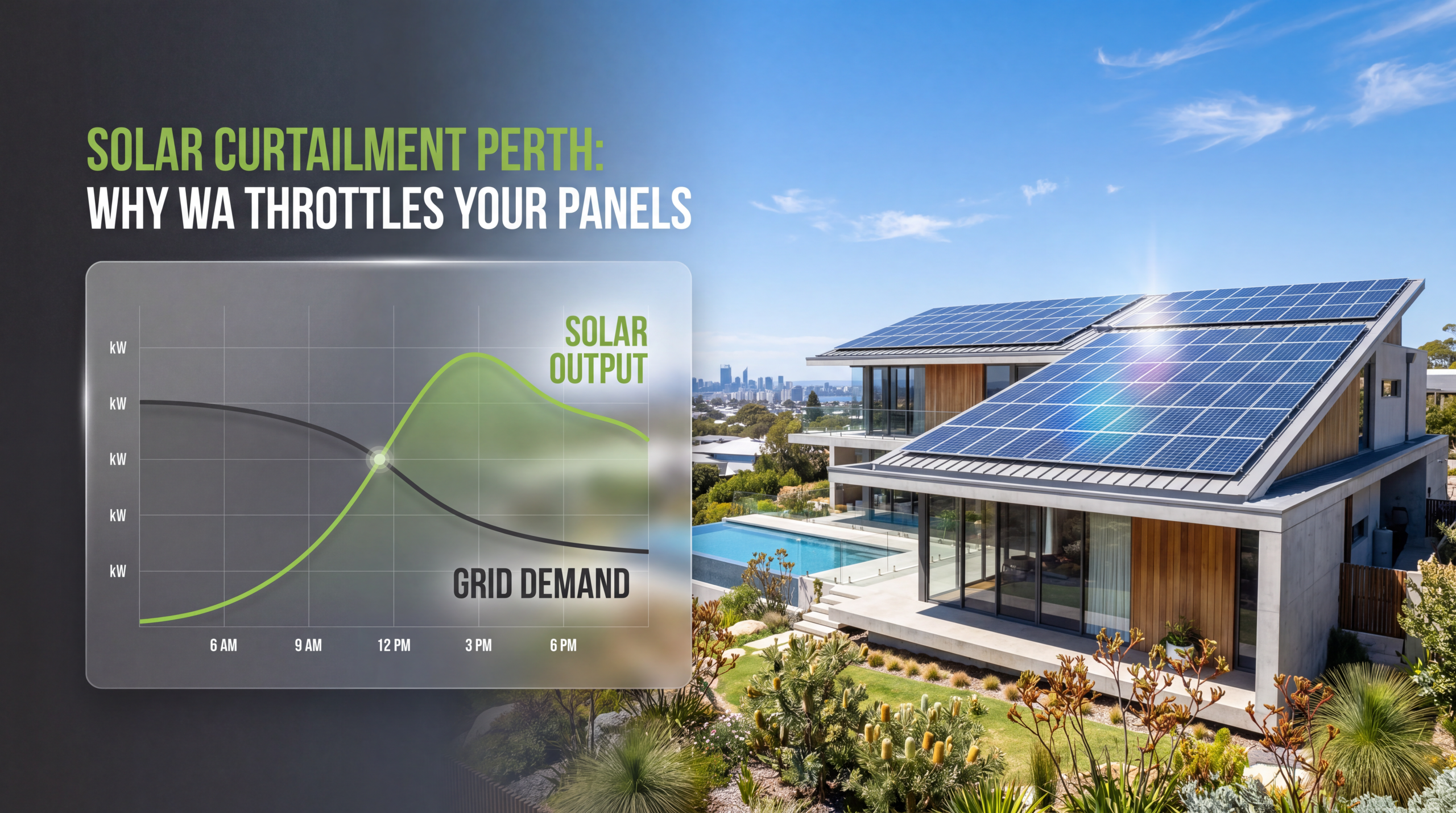
There is a moment that puzzles a growing number of Perth solar owners. It is a clear, mild Sunday in spring. The sky is cloudless, the panels are spotless, and yet the inverter app shows generation flatlining – or dropping away entirely – in the middle of the day. No fault code. No shading. Nothing wrong with the equipment at all. What those owners are seeing is solar curtailment: the deliberate, remote reduction of rooftop solar output to keep Western Australia’s isolated grid stable. It is not a fault, and despite the nickname doing the rounds in Perth Facebook groups, it is not a ‘solar tax’ either.
Curtailment has quietly become a routine feature of the WA grid rather than a rare edge case. This guide explains what is actually happening, why WA experiences it more acutely than any other Australian capital, what it costs a typical household, and – most usefully – the practical steps that recover almost all of the energy you might otherwise lose.
Why WA Curtails Solar When the Sun Is Shining
Western Australia runs the South West Interconnected System (SWIS) – the grid covering Perth and the south-west. Its defining feature is isolation: unlike the eastern states, it cannot lean on neighbouring networks to absorb a surplus or cover a shortfall. Balance has to be maintained entirely within WA, second by second.
That matters because of how much rooftop solar WA now has. Around 40 per cent of homes on the SWIS have rooftop solar, and on a clear day combined rooftop generation is often the single largest source of power on the grid – more than two gigawatts of it. (Source: AEMO WA DER Program.)
The problem is not peak demand. It is the opposite – minimum demand. On a mild, sunny weekend day, businesses are closed, air-conditioners are off, and household demand collapses while solar generation soars. The amount of power the grid actually needs from large generators – ‘operational demand’ – falls towards a floor below which the system becomes difficult to operate securely. AEMO has long identified roughly 700 MW as the level needed to keep the SWIS secure under most conditions, and minimum demand has been tracking down towards that zone for years. (Source: AEMO; Energy Policy WA.)
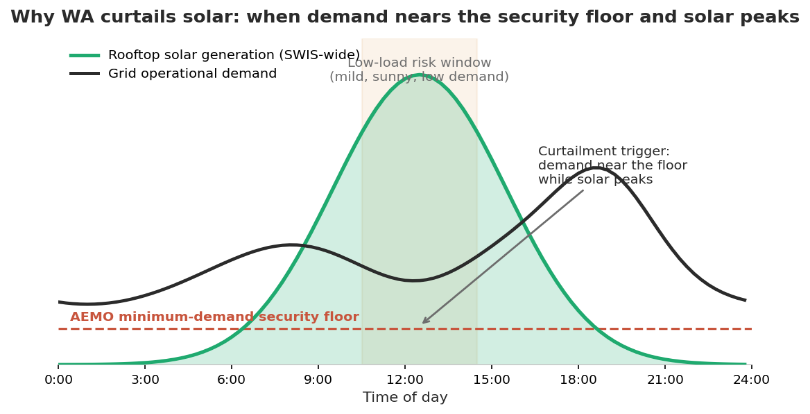
Figure 1: Curtailment is triggered when grid demand sinks toward the security floor at the same moment rooftop solar peaks.
Emergency Solar Management: The Mechanism Behind the Throttle
Since 14 February 2022, every new or upgraded rooftop system in the SWIS has had to be capable of being remotely turned down or off in an emergency low-load event. The scheme is called Emergency Solar Management (sometimes labelled DPV Management on older paperwork). It lets Synergy, on direction from AEMO and Western Power, reduce rooftop solar export during the rare windows when the grid would otherwise be pushed below its secure operating level. (Source: Energy Policy WA; Western Power.)
Crucially, your home keeps its power. Emergency Solar Management reduces what your system exports, not what your household consumes. The lights stay on, the fridge keeps running. What is curtailed is the surplus that would otherwise flow to the grid – and it is designed as a last resort, expected only a handful of times a year and for short periods.
It also does not act alone or first. AEMO follows an order of operations, reducing large-scale and commercial generation well before residential rooftop is touched:
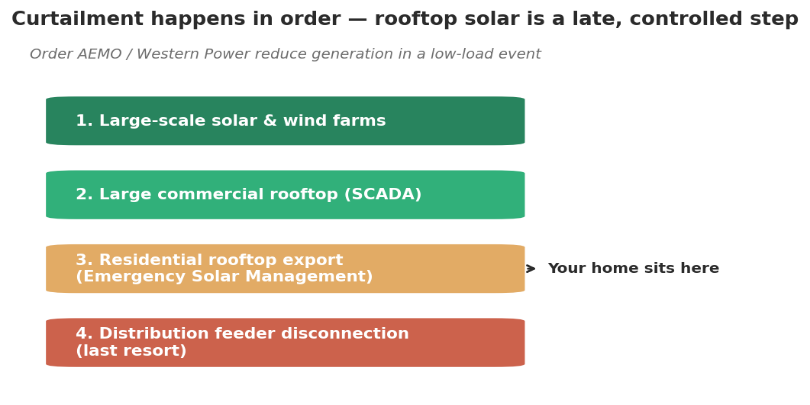
Figure 2: Residential rooftop export is a late, controlled step – not the first lever pulled.
Why Perth Feels This More Than Sydney or Melbourne
Three WA-specific realities concentrate the effect here:
- Grid isolation – The SWIS has no interconnector. Every other mainland capital can export a midday surplus across state lines; WA cannot. Surplus has to be managed internally.
- World-leading rooftop penetration – With around 40 per cent of SWIS homes carrying solar, the midday surplus is proportionally larger than almost anywhere on earth.
- The DEBS export structure – Synergy’s Distributed Energy Buyback Scheme pays roughly 2c/kWh for energy exported between 9am and 3pm – precisely the window when curtailment bites. So the energy most at risk of being curtailed is also the energy worth the least to export. (Source: Synergy DEBS.)
Put together, these mean the marginal value of chasing more midday export in Perth is now very low – and the strategic emphasis has shifted decisively towards using or storing that energy on site.
What Curtailment Actually Costs a Perth Household
For most homes the direct dollar cost of Emergency Solar Management events themselves is modest, precisely because events are infrequent and the off-peak export they interrupt is only worth about 2c/kWh. The larger, year-round cost is subtler: it is the everyday export ceiling that applies to systems on a fixed-export connection, combined with the low buyback rate. Energy sent to the grid at 2c that could have offset power you later buy at around 32c is the real leak.
The encouraging part is that the same fix addresses both problems at once. Whether your surplus is being curtailed in a low-load event or simply exported for 2c, the answer is to move that energy from ‘sent to the grid’ to ‘used in the home’.
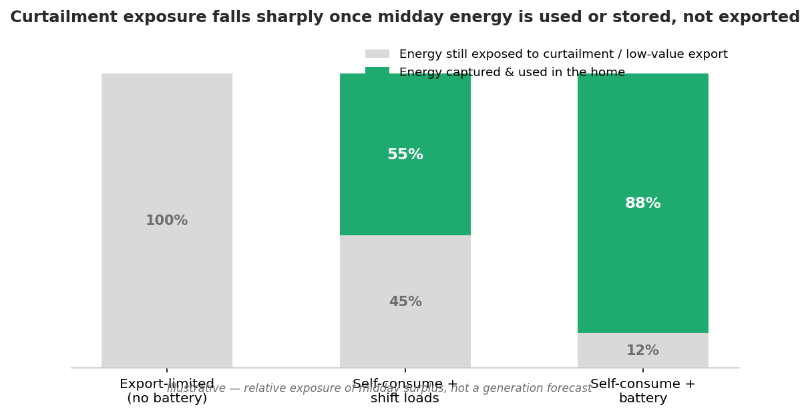
Figure 3: Exposure to curtailment and 2c export collapses once midday energy is self-consumed or stored rather than sent to the grid.
How to Stop Losing Free Energy – Five Practical Moves
None of these requires a new array. They are about capturing what you already generate.
- Shift big loads into the solar window – Run the dishwasher, washing machine, pool pump and hot-water heating between roughly 10am and 3pm. Every kilowatt-hour self-consumed at midday is one that cannot be curtailed and is not exported at 2c.
- Heat water with your surplus – A timed heat-pump or diverter-controlled element turns midday excess into stored hot water – effectively a cheap thermal battery.
- Charge the EV on sunlight – A smart Level 2 charger set to solar-only soaks up midday surplus that would otherwise be exported or curtailed, displacing petrol in the process.
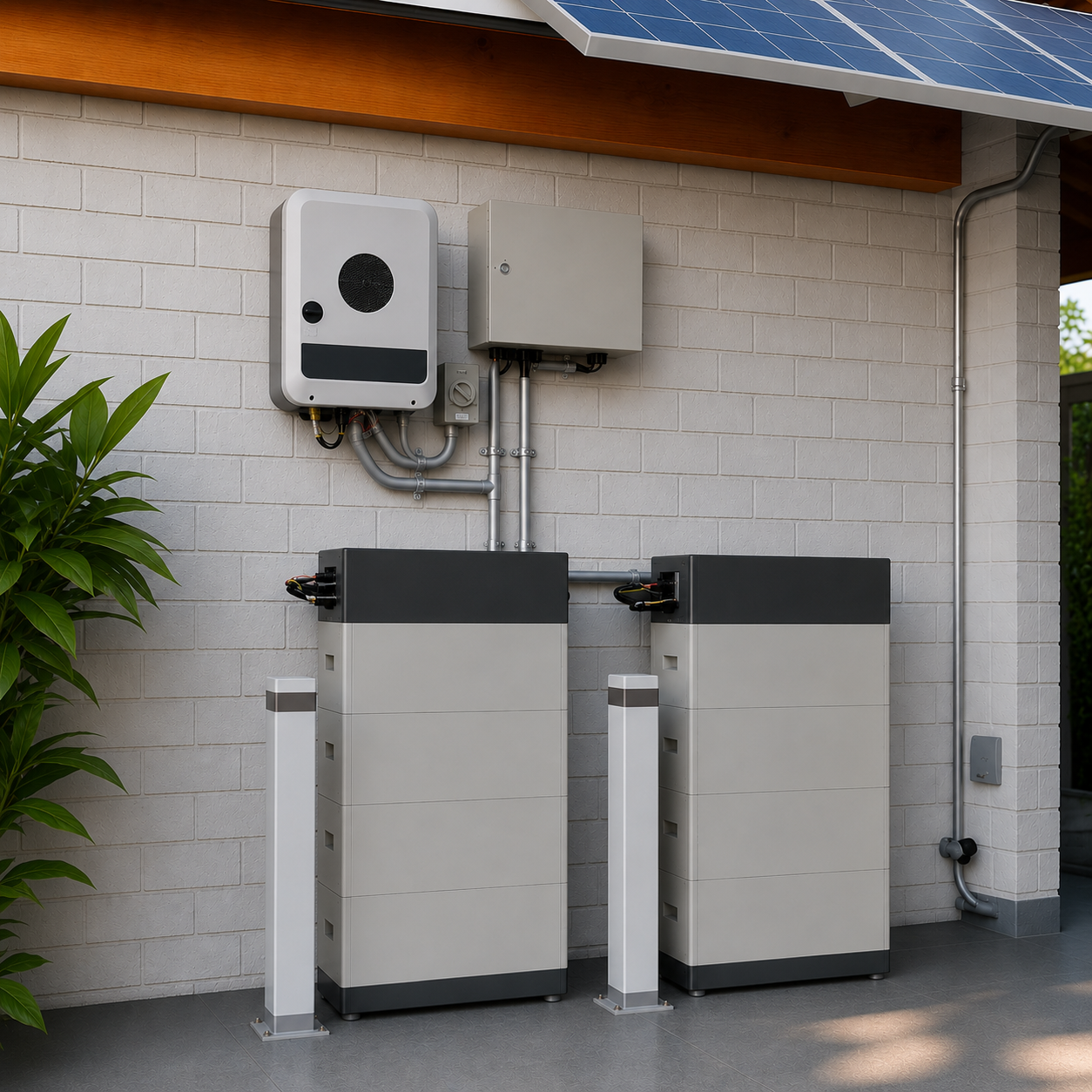
- Add a battery sized to your evening load – This is the single highest-leverage move. A battery captures the midday surplus and releases it across the 3pm-9pm window, when grid power is most expensive. It converts curtailment-exposed export into peak-rate self-consumption.
- Choose the Future-Ready connection on any new or upgraded system – Under WA’s post-1 May 2026 rules, the Future-Ready (CSIP-AUS) pathway preserves full DEBS access and flexible-export participation as those products roll out – rather than locking you to a hard 1.5 kW export cap.
Regen Power’s Perspective
Across more than 45,000 installations in Western Australia, the pattern is consistent: curtailment is not a reason to install less solar – it is a reason to design the whole system around self-consumption from day one. A correctly sized array paired with storage and smart loads barely notices an Emergency Solar Management event, because so little of its energy was destined for the grid in the first place. As an adjunct researcher at Curtin University, I would add that WA’s curtailment challenge is, in the longer view, a transitional one: flexible exports, dynamic operating envelopes and orchestrated VPPs are steadily replacing blunt curtailment with something far more rewarding for households. The systems being specified correctly today are the ones positioned to benefit.
The Bottom Line for Perth Homeowners
Curtailment is real, it is increasingly routine, and it is not a fault in your system or a tax on your generation. It is the predictable consequence of a world-leading rooftop fleet on an isolated grid. The owners who lose least are simply the ones who export least – because they have designed their homes to use the sunshine rather than give it away.
Stop exporting your sunshine for 2c. Book a free self-consumption and curtailment audit with Perth’s most awarded installer. We’ll model your interval data and show you exactly how much midday energy you can recover. Call 08 9456 3491 or request a quote at regenpower.com.
Frequently Asked Questions
Why is my solar being turned off in Perth on sunny days?
Most likely it is solar curtailment under Western Australia’s Emergency Solar Management scheme. On mild, sunny, low-demand days the SWIS grid can be pushed toward its minimum secure operating level, so AEMO directs a brief reduction in rooftop solar export. Your home keeps its power – only the surplus exported to the grid is reduced, and events are infrequent and short.
Is solar curtailment the same as a solar tax in WA?
No. There is no tax on the energy your solar generates or uses. Curtailment is a grid-stability measure that temporarily limits how much surplus you export during rare low-load events. The most effective response is to self-consume or store your midday surplus rather than export it.
Does Emergency Solar Management cut power to my house?
No. It reduces what your system exports to the grid, not what your household consumes. Your lights, fridge and appliances keep running normally throughout an event.
How can I stop losing solar energy to curtailment in Perth?
Move large loads into the 10am–3pm window, heat water and charge an EV from midday surplus, and – most effectively – add a battery sized to your evening load so midday energy is stored and used at night instead of exported. On new or upgraded systems, choose the Future-Ready (CSIP-AUS) connection pathway.
Will a battery help with curtailment in WA?
Yes. A battery captures midday surplus that would otherwise be exported at around 2c/kWh or curtailed, and releases it across the 3pm–9pm peak when grid power costs around 32c/kWh. It converts curtailment-exposed export into high-value self-consumption.