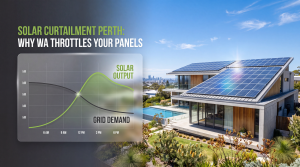

If you’ve been considering a home battery for your Perth property, 2026 is shaping up to be the single best year to act — but there’s a hard deadline approaching. The WA battery rebate 2026 landscape combines a generous state-funded scheme with a federal program that’s about to reduce significantly on 1 May 2026.
In this guide, we break down exactly how much you can save, who qualifies, what the Virtual Power Plant (VPP) requirement means for you, and why the window for maximum savings is closing. As Perth’s longest-serving solar company — with over 45,000 installations since 2003 — Regen Power has helped thousands of WA households navigate rebate programs, and this one is the most valuable we’ve seen.
How the WA Battery Rebate Works in 2026
The WA Residential Battery Scheme, launched in July 2025 by the State Government, provides a one-off rebate to eligible homeowners who install an approved battery storage system. The rebate is designed to make batteries more affordable and reduce pressure on Western Power’s grid during peak demand periods.
Here’s how the rebate breaks down: Synergy customers (Perth metro and South West) receive $130 per kWh of usable battery capacity, capped at $1,300 for a standard 10 kWh system. Horizon Power customers (regional WA) receive $380 per kWh, capped at $3,800.
But the state rebate is only part of the picture. The federal Cheaper Home Batteries Program (CHBP) provides an additional discount through Small-scale Technology Certificates (STCs), which currently delivers approximately $311 per usable kWh (based on current STC trading prices of around $37 each, after administration costs).
Combined Rebate Breakdown: 10 kWh Battery (Synergy Customer)
| Rebate Source | Amount (10 kWh) |
| WA Residential Battery Scheme (Synergy) | $1,300 |
| Federal CHBP (STCs at current rate) | ~$3,110 |
| Total rebate value | ~$4,410 |
| Interest-free loan available (optional) | Up to $10,000 |

Combined battery rebates for Synergy and Horizon Power customers installing a 10 kWh system before May 2026.
For Horizon Power customers in regional WA, combined rebates can reach approximately $6,910 for a 10 kWh system — making it among the most generous battery incentive packages anywhere in Australia.
The May 2026 Deadline: Why Timing Matters for Your WA Battery Rebate
This is the critical detail most guides bury. On 1 May 2026, the federal STC deeming period reduces, which directly lowers the federal rebate component of your battery purchase.
Before 1 May 2026: STCs deliver ~$311 per usable kWh. After 1 May 2026: This drops to ~$244 per kWh — a reduction of ~$67 per kWh. On a 13.5 kWh Tesla Powerwall 3, that’s roughly $900 less in federal rebate.
The federal program also introduces a tiered structure from May 2026. The first 14 kWh of capacity receives around $244/kWh. Capacity from 15–28 kWh receives 60% of the base rate (~$146/kWh). From 29–50 kWh, only 15% of the base rate (~$37/kWh). This tiering particularly affects households considering larger battery systems for full off-grid capability or EV charging integration.

The federal STC rebate drops significantly on 1 May 2026. Acting before this deadline maximises your total savings.
In our experience installing thousands of battery systems across Perth, we consistently advise homeowners: the best time to install is when the rebate is at its highest, not when the battery price drops by a few percent. Rebate reductions almost always outpace manufacturer price decreases.
Eligibility: Who Qualifies for the WA Battery Rebate?
To access the WA Residential Battery Scheme, you must meet the following criteria:
- You own and live in the property — it must be your primary residence in Western Australia.
- You have an existing or new solar PV system — the battery must be paired with a solar installation.
- The battery must be on the approved product list — only batteries that meet Australian standards and are listed by the Clean Energy Council qualify.
- Installation by an approved retailer and installer — your installer must be a CEC-accredited installer, and the retailer must be a CEC Approved Solar Retailer (like Regen Power, EC9676).
- VPP enrolment — you must agree to participate in a Virtual Power Plant program.
- No previous battery rebate — you cannot have previously received a rebate under this scheme.
Interest-Free Loan Eligibility
Your combined household income must be under $210,000 per year. Loans range from $2,001 to $10,000, repaid over 10 years at zero interest through Plenti. The loan can cover both solar and battery costs.
VPP Participation: What It Actually Means for Perth Homeowners
The Virtual Power Plant (VPP) requirement is the part of the WA battery rebate that generates the most questions from our customers. When you enrol in a VPP, you agree to let your battery participate in a coordinated network. During periods of peak grid demand — typically hot summer afternoons between 3 pm and 9 pm in Perth — the VPP operator can discharge a portion of your stored energy back to the grid. In return, you may receive credits or payments for the energy exported.
Your battery will still power your home first. VPP dispatch events typically use only a portion of your stored energy and occur relatively infrequently. Synergy’s Community Virtual Power Plant is the most common option for Perth metro customers.
Across our 45,000+ installations, we’ve found that well-sized battery systems (10–13.5 kWh for a typical 4-person Perth household) comfortably handle VPP dispatch events without impacting household energy security. Dr. Nikhil Jayaraj, Regen Power’s Managing Director and a published researcher in the Energy Policy journal on solar storage and EV adoption, notes: “For most Perth households, VPP participation is not a sacrifice — it’s an additional revenue stream that improves your battery’s return on investment.”
Real Costs and Savings: What a Battery Actually Costs in Perth After Rebates
Let’s put real numbers on the table. Here’s a cost comparison for three popular battery systems installed in the Perth metro area in early 2026, factoring in current rebates:
| Battery System | Capacity | Installed Cost | Total Rebates | Net Cost |
| Sungrow SBR 9.6 | 9.6 kWh | $9,500–$11,500 | ~$4,238 | $5,262–$7,262 |
| BYD HVS 10.2 | 10.2 kWh | $11,000–$13,000 | ~$4,470 | $6,530–$8,530 |
| Tesla Powerwall 3 | 13.5 kWh | $13,500–$15,500 | ~$5,500 | $8,000–$10,000 |
Costs are indicative for Perth metro area as at Q1 2026, including GST. Actual pricing varies.

Net battery costs after all rebates for popular systems available in Perth.
Payback Period
Perth’s exceptional solar resource — averaging 5.8 peak sun hours per day — means batteries charge reliably almost year-round. With Synergy’s flat tariff sitting around 30–35 cents per kWh and the DEBS feed-in tariff as low as 2.25 cents per kWh during peak solar hours, the economics strongly favour storing your solar energy rather than exporting it.

Storing your solar energy delivers roughly 14 times more value than exporting it to the grid.
A well-configured 10 kWh battery system can save a typical Perth household between $1,200 and $1,800 per year on electricity bills by shifting solar energy from daytime export to evening self-consumption. At the net cost after rebates, that translates to a payback period of roughly 4 to 6 years — and the battery’s warranted life is typically 10 to 15 years.
WA Battery Rebate vs. Waiting: The Financial Case for Acting Now
About the In Favour of Acting Before May 2026
- Federal STCs drop ~$670 per 10 kWh on 1 May 2026. Battery prices are unlikely to fall by that amount in the same period.
- The WA scheme is funded for 100,000 rebates. Availability is first-come, first-served.
- Synergy electricity prices have increased every year since 2020. Each year you delay is another year paying 30c+ per kWh for evening power.
- The interest-free loan makes the upfront cost manageable — $10,000 over 10 years is less than $20 per week with zero interest.
In Favour of Waiting
- Battery costs may continue to decline as manufacturing scales up globally.
- New battery chemistries (such as sodium-ion) may enter the Australian market, increasing competition.
On balance, the financial modelling strongly favours acting while the combined rebate value is at its peak. As Dr. Jayaraj’s research at Curtin University has demonstrated, the intersection of rebate timing, electricity price trajectories, and battery cost curves creates an optimal adoption window — and for WA, that window is open right now.
How to Apply for the WA Battery Rebate: Step-by-Step
- Get a personalised assessment. Contact a CEC Approved Solar Retailer like Regen Power for a site assessment. We’ll evaluate your current solar system, your household energy consumption, and recommend the right battery size.
- Receive your quote and rebate breakdown. Your installer will provide a detailed quote showing the gross cost, applicable WA rebate, federal STC discount, and your net out-of-pocket cost.
- Accept the quote and your installer applies for the rebate. Once you proceed, your CEC Approved Solar Retailer handles the rebate application through the scheme portal.
- Installation and VPP enrolment. Your battery is installed by a licensed electrician. After installation, you’re enrolled in the VPP program, and the rebate is applied as a point-of-sale discount.
- Start saving. From day one, your battery stores excess solar energy during the day and powers your home in the evening, slashing your reliance on grid electricity.
Solar + Battery + EV: The Integration Advantage Perth Homeowners Are Missing
Here’s something most WA battery guides overlook entirely: the compounding value of integrating your battery with an EV charger. With EV adoption accelerating in Perth and petrol prices remaining volatile, a solar + battery + EV charger setup allows you to charge your electric vehicle with free solar energy.
A 6.6 kW solar system in Perth generates roughly 38 kWh per day on average. A typical EV commute of 40 km uses about 7–8 kWh. That’s energy you’re already generating on your roof. With a battery in the system, you can charge your EV overnight from stored solar rather than drawing from the grid at peak tariff rates. The savings compound: you’re offsetting both your electricity bill and your fuel costs with the same solar investment.

Integrated solar + battery + EV charging maximises the return on every component of your energy system.
Regen Power is one of the few Perth installers that designs and installs fully integrated solar, battery, and EV charging systems. Explore our residential solar packages.
Frequently Asked Questions About the WA Battery Rebate 2026
How much is the WA battery rebate in 2026?
The WA Residential Battery Scheme provides $130 per kWh for Synergy customers (capped at $1,300) and $380 per kWh for Horizon Power customers (capped at $3,800). When combined with the federal Cheaper Home Batteries Program, total rebate value for a 10 kWh battery in the Perth metro area is approximately $4,410 before 1 May 2026.
What is the deadline for the WA battery rebate?
The WA Residential Battery Scheme is expected to remain open until 2027 or until 100,000 rebates are distributed. However, the federal STC component reduces significantly on 1 May 2026, lowering the total rebate package by approximately $670 per 10 kWh. Acting before May 2026 maximises your total savings.
Do I need solar panels to get the WA battery rebate?
Yes. The WA Residential Battery Scheme requires your battery to be paired with a solar PV system — either an existing system on your roof or a new solar installation done at the same time as the battery.
What is the VPP requirement for the WA battery rebate?
To receive the WA battery rebate, you must enrol in a Virtual Power Plant (VPP) program. This means your battery may occasionally export stored energy to the grid during peak demand periods. You’re typically compensated for this energy, and VPP events are managed so your household energy needs are still met.
Can I get the WA battery rebate if I already have solar?
Yes. If you already have a solar system installed at your primary residence in WA, you can add a battery and still access the full WA Residential Battery Scheme rebate plus federal STCs for the battery component — provided you haven’t previously received a battery rebate under this scheme.
How much does a home battery cost in Perth after rebates?
After applying both the WA state rebate and federal STCs, a 10 kWh battery system in Perth typically costs between $5,200 and $8,500 net (as at Q1 2026). The exact cost depends on the battery brand, your existing electrical infrastructure, and whether a switchboard upgrade is required.
Ready to claim your WA battery rebate before the May 2026 deadline? Get your free personalised solar assessment from Perth’s most awarded installer. Call 08 9456 3491 or request a quote at regenpower.com.
About the Author
Dr. Nikhil Jayaraj is the Managing Director of Regen Power, Perth’s longest-established solar energy company. A Research Adjunct at Curtin University, Dr. Jayaraj has published peer-reviewed research in the Energy Policy journal on solar storage adoption and EV integration in Australian households. Under his leadership, Regen Power has completed over 45,000 residential and commercial solar installations across Western Australia.
Awards: WA No. 1 Combined Volume Installer (Sunwiz 2023) | Best Rated Solar Company in Australia (Sunwiz 2025) | ProductReview Award Winner 2021–2026 (6 consecutive years) | EUPD Top Brand PV Installer 2023 & 2024 | AFR Fast 100 | FT High-Growth Asia-Pacific
Accreditations: CEC Approved Solar Retailer | Electrical Contractor Licence EC9676