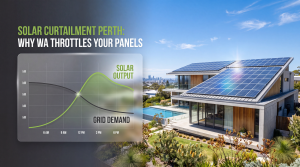

If you’re a Perth homeowner considering solar panels or a battery system, there’s a date you need to have circled on your calendar: 1 May 2026. On that day, significant new WA solar rules take effect across the South West Interconnected System (SWIS), changing how new solar and battery systems connect to the Western Power grid. At the same time, the federal Cheaper Home Batteries Program drops its rebate from $300 per kWh to $244 per kWh, and STC certificates reduce in value.
The result? Installing before May means simpler connection requirements, higher rebates, and potentially thousands of dollars in savings. In this guide, we’ll break down exactly what’s changing, what it means for your home, and how to make the smartest decision for your energy future.
What Are the New WA Solar Rules Starting 1 May 2026?
From 1 May 2026, all new and upgraded rooftop solar and battery systems connected to the SWIS network — which covers Perth, the South West, and the Great Southern region — must meet updated connection and commissioning requirements set by Western Power and Energy Policy WA.
These changes have been developed to manage the growing amount of rooftop solar on WA’s electricity grid. Western Australia now has one of the highest per-capita rates of rooftop solar in the world, and while that’s excellent for clean energy, it creates challenges during low-demand periods when more power is being exported than the grid can handle.
Here’s what’s actually changing:
Larger inverter capacity allowed (with conditions). Households on a standard connection can now install total inverter capacity up to 30 kVA — up from the previous limits. However, this comes with a trade-off: your system must either support Emergency Solar Management (ESM), which allows remote disconnect and reconnect capability, or accept a fixed 1.5 kW export limit.
New inverter commissioning standards. All inverters installed after 1 May must be commissioned to AS/NZS 4777.2:2020 with the correct “Australia Region B” settings. This ensures inverters respond appropriately to grid frequency and voltage changes — a critical safety requirement.
CSIP-AUS protocol compliance. For Synergy customers, systems must follow the open-source CSIP-AUS (Common Smart Inverter Profile — Australia) protocol. This enables standardised communication between your inverter and the grid, paving the way for smarter energy management across the network.
In our experience installing thousands of systems across Perth over the past 23 years, we’ve seen regulatory changes before — but this is one of the most significant shifts in how residential solar connects to the WA grid.
How the New WA Solar Rules Affect Your Installation Options
So what do these new rules mean in practical terms? Let’s break it down into a simple comparison.
Before vs. After 1 May 2026: Connection Rules at a Glance
| Feature | Before 1 May 2026 | After 1 May 2026 |
|---|---|---|
| Max inverter capacity | Up to 5 kVA (standard) | Up to 30 kVA (standard connection) |
| Export limits | Varies by approval | ESM-enabled OR capped at 1.5 kW export |
| Inverter settings | AS/NZS 4777.2:2015 acceptable | Must use AS/NZS 4777.2:2020 Region B |
| CSIP-AUS compliance | Not required | Required for Synergy customers |
| Existing systems | N/A | Fully grandfathered — no changes needed |
The critical takeaway: systems installed and commissioned before 1 May 2026 are completely grandfathered. They won’t be subject to any of the new requirements. This means if you install now, you lock in the current, simpler connection framework.
For homeowners who want a straightforward installation without worrying about ESM capability or CSIP-AUS compliance, acting before the deadline is the clearest path forward.
Federal Battery Rebate Drops on 1 May 2026 — What You’ll Lose by Waiting
The timing of the WA rule changes coincides with a significant reduction in the federal Cheaper Home Batteries Program rebate. Here’s how the numbers shift:
Current rebate (January–April 2026): $300 per kWh of battery capacity. For a typical 10 kWh home battery, that’s $3,000 in federal battery rebate.
From 1 May 2026: The rebate drops to $244 per kWh for the first 14 kWh, with further reductions for larger capacities (60% for 15–28 kWh, and just 15% for 29–50 kWh). For the same 10 kWh battery, you’d receive approximately $2,440— a loss of $560.
On top of this, STC (Small-scale Technology Certificate) values also step down. A 10 kWh battery system installed between January and April 2026 receives approximately 84 STCs (worth around $3,360), but the same system installed from May onwards receives roughly 68 STCs (around $2,720) — that’s a 19% reduction worth approximately $640.
Combined Savings: Install Before vs. After May 2026
| Rebate/Incentive | Before May 2026 | After May 2026 | Difference |
|---|---|---|---|
| Federal battery rebate (10 kWh) | ~$3,000 | ~$2,440 | -$560 |
| STCs (10 kWh battery) | ~$3,360 | ~$2,720 | -$640 |
| WA Battery Scheme (Synergy) | Up to $1,300 | Up to $1,300 | No change |
| Total potential incentives | ~$7,660 | ~$6,460 | -$1,200 |
That’s roughly $1,200 more in your pocket by acting before the May deadline — and that’s before you factor in the simpler connection process under current rules.
The Full Picture: Every Solar and Battery Rebate Available in Perth Right Now
Perth homeowners have access to a remarkable stack of incentives in early 2026. Here’s the complete breakdown:
1. Federal STCs (Solar Rebate) The federal government’s Small-scale Renewable Energy Scheme provides upfront savings through STCs. For a 6.6 kW solar system in Perth (Zone 2), this typically saves around $1,600 off the installation cost. STCs reduce annually on 1 January and again at certain intervals, so 2026 values are higher than 2027.
2. Federal Cheaper Home Batteries Program Currently providing approximately $300 per kWh (dropping to $244/kWh from May). The Australian Government recently expanded this programme from $2.3 billion to an estimated $7.2 billion, targeting 2 million Australian battery installations by 2030.
3. WA Residential Battery Scheme The state government’s scheme provides:
- $130 per kWh for Synergy customers (up to $1,300 for a 10 kWh battery)
- $380 per kWh for Horizon Power customers (up to $3,800 for a 10 kWh battery)
This scheme requires your battery to be VPP (Virtual Power Plant) capable. In practice, this means your battery must have the technical ability to participate in a VPP programme — it doesn’t mean a third party will constantly control your battery.
4. Interest-Free Loan Eligible households with a combined annual income under $210,000 can access a no-interest loan of up to $10,000, repayable over up to 10 years through provider Plenti. This makes battery storage accessible without any upfront financial pressure.
5. Tesla Manufacturer Rebate (Limited Time) Tesla is currently offering up to $1,500 back on Powerwall 3 systems ($750 per unit), but orders must be placed by 31 March 2026, with installation completed by 30 September 2026.
Across our 45,000+ installations, we’ve helped thousands of Perth families navigate these incentive programmes to maximise their savings. The current window — with federal, state, and manufacturer rebates all available simultaneously — is one of the strongest we’ve ever seen.
Why Battery Storage Makes More Financial Sense Than Ever in Perth
With Perth’s DEBS (Distributed Energy Buyback Scheme) feed-in tariff sitting at just 2.25 cents per kWh during off-peak hours and 10 cents per kWh during the 3pm–9pm window, the financial case for battery storage has never been clearer.
Consider this: Synergy’s standard residential electricity rate is approximately 28–35 cents per kWh. Every kilowatt-hour of solar energy you store in a battery and use in the evening saves you that full retail rate, rather than earning you just 2.25 cents by exporting it to the grid.
For a typical Perth household using a 10 kWh battery system:
- Daily savings from self-consumption: approximately $2.50–$3.50 per day
- Annual savings: approximately $900–$1,275
- System cost after all rebates: approximately $4,000–$7,000
- Estimated payback period: 4–6 years
With Perth averaging 5.8 peak sun hours per day — one of the highest solar irradiance levels of any capital city globally — a well-sized solar and battery system can cover 80–90% of a household’s electricity needs.
Dr. Nikhil Jayaraj, Regen Power’s Managing Director and Curtin University research adjunct, has published research in the Energy Policy journal on solar storage adoption patterns. His findings consistently show that households combining solar with battery storage in high-irradiance regions like Perth achieve the fastest payback periods in the country.
What Happens If You Wait Until After May 2026?
Let’s be clear: installing solar and batteries after May 2026 will still be a smart investment. The sun isn’t going anywhere, and electricity prices in WA have risen approximately 2.7% annually over the past decade. But there are tangible costs to waiting:
Higher out-of-pocket costs. You’ll lose approximately $1,200 in combined federal rebates and STC value on a 10 kWh battery system. The WA Battery Scheme also runs until its allocated budget is exhausted — there’s no guarantee funds will remain available indefinitely.
More complex installation requirements. New CSIP-AUS compliance, ESM capability, and updated inverter commissioning standards add technical requirements. While quality installers (like CEC Approved Solar Retailers) will handle these seamlessly, it may add to installation timelines.
Continued electricity price rises. Every month you wait is another month paying full retail electricity rates. With Synergy’s next tariff review expected around July 2026, prices are unlikely to decrease.
Declining feed-in tariffs. DEBS rates have dropped over 30% since 2020, and the trend is expected to continue. The economics increasingly favour storing your solar energy rather than exporting it.
How to Choose the Right Installer Before the May Deadline
With the deadline approaching, it’s important to choose an installer who can deliver quality without cutting corners. Here’s what to look for:
CEC Approved Solar Retailer status. This is mandatory for accessing government rebates and ensures the company meets the Clean Energy Council’s quality and consumer protection standards. Regen Power holds CEC Approved Solar Retailer accreditation and Electrical Contractor Licence EC9676.
Proven track record in WA. Look for companies with substantial local experience. Perth’s grid conditions, climate, and regulatory environment are unique — national companies without deep WA expertise may not understand the nuances of Western Power’s requirements.
Consultancy-led approach. Avoid companies that push a one-size-fits-all system. Your home’s energy consumption pattern, roof orientation, shading, and future needs (including EV charging) should all inform your system design.
Transparent pricing and real data. Be wary of quotes that seem too good to be true. Quality components, proper installation, and post-installation support all cost money. As a company that has earned the ProductReview Award for six consecutive years (2021–2026) and been recognised as the EUPD Top Brand PV Installer in 2023 and 2024, we believe in providing honest assessments backed by real performance data.
Warranty and support. Your solar and battery system should last 25+ years. Choose a company that will still be around to honour warranties and provide support. Regen Power has been operating in Perth since 2003 — over 23 years of continuous service.
Frequently Asked Questions
Do the new WA solar rules affect my existing solar system?
No. If your system was installed and commissioned before 1 May 2026, it is fully grandfathered. You don’t need to make any changes or upgrades to comply with the new requirements.
Can I still get the WA Battery Scheme rebate after May 2026?
Yes — the WA Residential Battery Scheme is expected to continue, subject to available funding. However, the separate federal Cheaper Home Batteries Program rebate will be lower from May onwards ($244/kWh instead of $300/kWh), reducing your total combined savings.
What is CSIP-AUS and why does it matter?
CSIP-AUS (Common Smart Inverter Profile — Australia) is an open-source communication protocol that enables your inverter to communicate with the grid in a standardised way. From May 2026, Synergy customers installing new systems will need CSIP-AUS compliant equipment. This helps manage grid stability as more homes adopt solar.
What does “Emergency Solar Management” mean for my system?
Emergency Solar Management (ESM) gives the network operator the ability to remotely disconnect and reconnect your solar export during rare grid emergencies. If your system supports ESM, you can export your full capacity. If not, your export will be capped at 1.5 kW. ESM activation is expected to be infrequent — it’s a safety mechanism, not routine control.
How long does a solar and battery installation take in Perth?
A typical residential installation takes 1–2 days for the physical work, but the full process — including site assessment, system design, approvals, and Western Power connection — usually takes 4–8 weeks from deposit to switch-on. Given the May deadline, starting the process in March or early April is advisable.
Is it worth adding a battery if I already have solar panels?
In most cases, yes. With DEBS feed-in rates as low as 2.25c/kWh and Synergy retail rates around 28–35c/kWh, storing your excess solar rather than exporting it saves significantly more money. Adding a battery to an existing solar system also qualifies for the WA Battery Scheme and federal rebates.
Act Before May 2026 to Maximise Your Solar Investment
The convergence of new WA solar rules, declining federal rebates, and reducing STC values makes the window between now and 1 May 2026 one of the most compelling times to invest in solar and battery storage in Perth’s history.
By installing before the deadline, you lock in higher rebates (saving approximately $1,200 on a 10 kWh battery), avoid the new CSIP-AUS and ESM connection requirements, and start saving on your electricity bills immediately — all while Perth’s 5.8 peak sun hours work in your favour.
Get your free personalised solar assessment from Perth’s most awarded installer. Call 08 9456 3491 or request a quote at regenpower.com